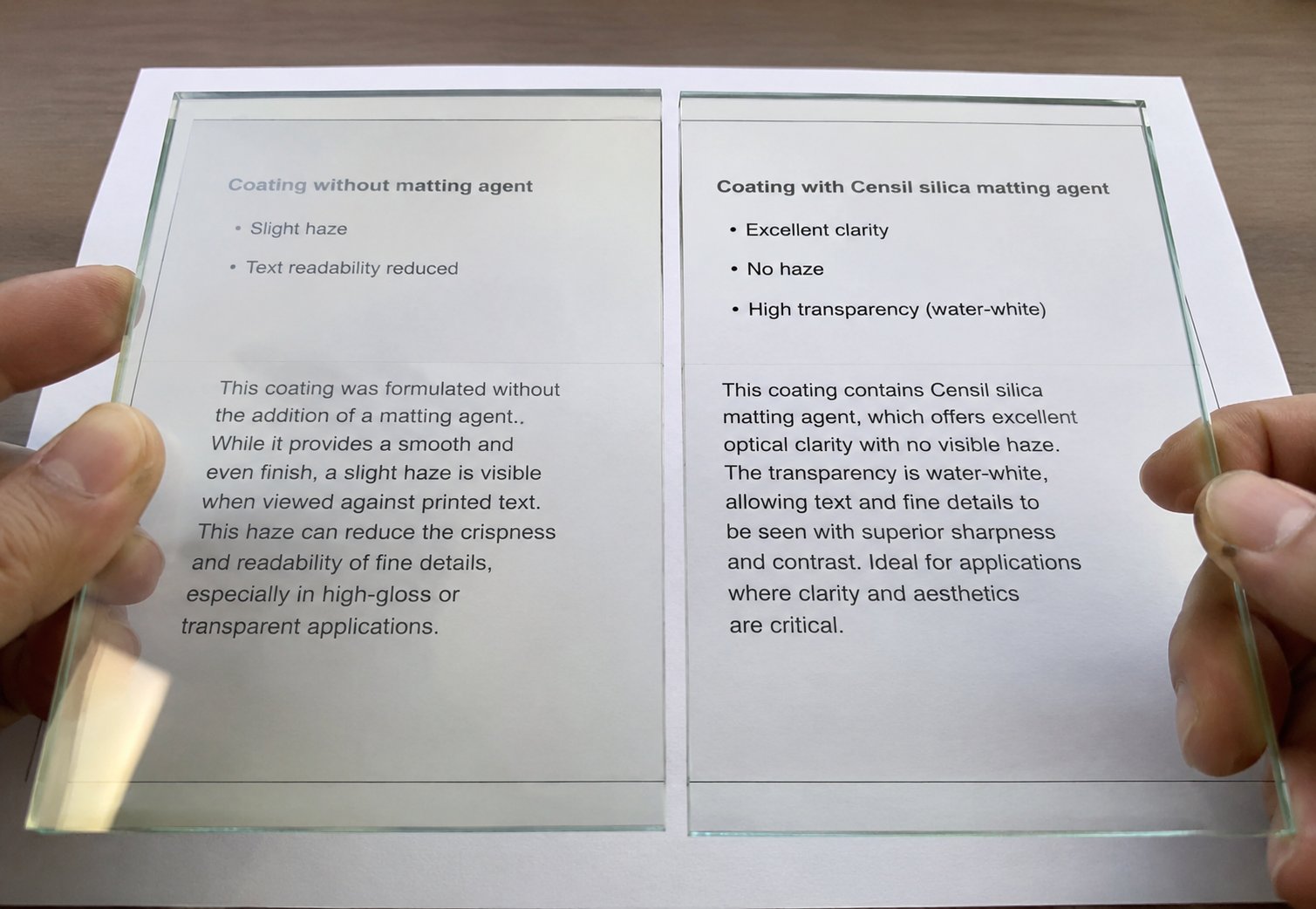
Haze in a matte clear coat is the milky, grey or "dusty" veil that makes a waterborne finish look cloudy instead of clear, and it shows worst over dark wood, black plastic or deep stains. A low-gloss clear will always scatter some light, because that is how matting works, but a well-formulated haze matte clear coat should still let the grain read sharp and the colour stay deep. When it does not, the cause is almost always one of six things: the matting agent's particle size, refractive-index and pore effects, moisture during film formation, poor dispersion or flocculation, incompatible additives, or film build and application. This guide explains each mechanism, how to tell them apart in the lab, and what to change.
It is written for formulators and QC chemists working on waterborne wood and plastic topcoats, and for buyers who need to judge whether a haze complaint is a material problem or a process problem.
What haze in a matte clear coat actually is
Gloss falls when the dry film surface becomes micro-rough, so incoming light is reflected in many directions instead of one. That is the intended effect of a silica matting agent: as the waterborne film shrinks during drying, the particles near the surface create a controlled roughness. Haze is different. It is light scattered inside the film, from anything whose refractive index differs from the cured binder: air voids, trapped water, flocculated particle clusters, incompatible droplets or the silica itself if it is too coarse or poorly wetted.
Two practical consequences follow. First, gloss and haze are separate measurements: two panels can both read 20 GU at 60° and look completely different over a black substrate. Second, internal scatter is most visible against a dark background, because the scattered white light is no longer masked by a light-coloured substrate. That is why haze complaints cluster on walnut, wenge, black-stained oak and dark plastic housings.
Cause 1: Matting agent particle size and distribution
For a given dosage, larger particles produce more surface roughness and so more matting, but they also scatter more light inside the film and can protrude as visible sparkle or greying. The average size (d50) sets the overall balance, while the coarse tail of the distribution often decides whether a clear looks hazy. A handful of oversized particles or hard agglomerates contributes far more scatter than their share of the mass would suggest.
- Too coarse for the film build. As a general rule of thumb, the matting particle should be small relative to dry film thickness. A grade that works in a 40 μm furniture topcoat may look grey in a 15 μm plastic clear.
- Wide distribution. Compare not just d50 but d90 or the upper percentile on the COA when screening grades for clarity.
- Overdosing to chase gloss. Adding more of an inefficient grade raises the number of scattering sites. If a grade needs well above the usual 1–4% range to hit target, re-select rather than add more.
Cause 2: Refractive-index mismatch and unfilled pores
Amorphous silica has a refractive index of roughly 1.45–1.46, close to many acrylic and polyurethane binders, which is one reason it is the standard matting material for clears. The match is good but not perfect, and it only holds if the binder (or at least something with a similar index) wets the silica's surface and pores. Precipitated matting silica is highly porous. If air remains trapped in the pores, each particle behaves like a tiny air-filled scatterer, and haze rises sharply.
Common contributors are a binder that is too high in molecular weight or too fast-drying to penetrate the particle, insufficient wetting additive, and a matting agent added straight into a high-viscosity letdown where it never fully wets. Signs of this mechanism: haze that is visible even at low silica loading, and haze that decreases if the same paint is dispersed longer at the same tip speed or given more open time before forced drying.
Cause 3: Moisture, humidity and incomplete coalescence
Waterborne clears form a film by evaporation followed by coalescence of polymer particles. If water leaves too slowly (high humidity, low temperature, poor airflow) or the outer skin seals too early, water and voids can be locked into the film. The result is blushing or whitening that may partly recover as the film dries further, or stay permanent if coalescence was never completed.
- Haze appears or worsens on humid days, in cold shops, or with heavy wet films.
- Panels dried under controlled conditions look clear, while line samples look grey.
- The effect is often stronger with hydrophilic, untreated silica, which can hold water at its surface.
Fixes include checking the coalescent level against the binder's minimum film formation temperature, controlling flash-off temperature and airflow, reducing wet film per coat, and choosing a wax-treated, more hydrophobic matting grade. Our dedicated article on whitening in waterborne matte coatings at high humidity covers the two mechanisms and a dark-panel diagnosis test in detail.
Cause 4: Poor dispersion, flocculation and seeding
Matting silica only needs wetting and deagglomeration, not grinding, but it does need that step done properly. Under-dispersed lumps act as large scattering centres. Just as important is what happens after dispersion: silica that is well separated in the tank can flocculate again when the system is destabilised.
- Thickener interactions. Some associative or cellulosic thickeners can bridge or deplete silica particles into loose flocs, giving a cloudy film and sometimes an uneven sheen.
- pH or solvent shock. Adding coalescent undiluted, or a large pH adjustment late in the batch, can locally destabilise the emulsion and the silica.
- Ageing. Haze that increases after weeks of storage, together with a rise in viscosity or a change in gloss, often points to slow flocculation rather than a raw-material defect.
Check fineness of grind (ISO 1524 / ASTM D1210) against a reference batch and look for specks or streaks, then compare a fresh batch with one stored at elevated temperature. Our guide to dispersing matting agents without bead milling sets out the disperser settings and order of addition.
Cause 5: Incompatible additives
Many hazy clears contain a perfectly good matting agent. The haze comes from something else that does not dissolve or match index with the cured binder:
| Additive | How it causes haze | What to try |
|---|---|---|
| Defoamer (mineral oil or some silicone types) | Incompatible droplets scatter light; overdose gives cloudiness and craters | Ladder the dose; switch to a defoamer recommended for clear systems |
| Wax emulsion for slip or scratch | Wax particles with a different refractive index, or crystallising in the film | Lower the level; test finer or more compatible wax types |
| Surfactants and wetting agents | Excess migrates to the surface or forms domains, especially in humid curing | Use the minimum effective level; avoid stacking several surfactants |
| Coalescent | Too little leaves voids; a poorly compatible one can phase separate | Check against binder MFFT and the resin supplier's recommendation |
| Crosslinker in 2K systems | Poor mixing or an incompatible hardener gives a cloudy film | Pre-dilute and mix thoroughly; respect pot life |
The quickest way to find an additive problem is subtraction: make the clear without the matting agent and draw it down over a black panel or glass. If the unmatted film is already cloudy, the matting agent is not your main issue.
Cause 6: Film build, recoats and application
Haze scales with the amount of scattering material in the light path. Every extra micron of dry film and every extra coat of matted clear adds to it, which is why a finish that looks fine as one coat can look grey after a sealer, a mid-coat and a topcoat, all matted. Typical process causes:
- Matting every layer. Sealers and intermediate coats often do not need a matting agent at all; gloss is set by the final coat. Leaving silica out of the lower layers can clear up a "milky" system.
- Heavy wet film per pass. Thick films dry slowly, trap water and let particles redistribute, increasing both haze and gloss variation.
- Dry spray and overspray. Droplets that arrive partly dried cannot flow out, leaving a rough, light-scattering layer.
- Sanding dust and contamination. Residue from sanding between coats shows as greying, especially over dark stains.
A lab sequence to find the cause
Work through these steps before changing raw materials:
- Black-panel drawdown. Draw down the problem batch and a retained good batch side by side on black Leneta charts or black glass at the production film thickness. Assess visually under a consistent light source and, if available, with a colorimeter (a lighter L* over black indicates more scatter).
- Unmatted control. Draw down the same base without matting agent. Cloudy without silica points to additives, coalescence or binder (causes 3 and 5).
- Dosage ladder. Draw down at, for example, 1%, 2%, 3% and 4% matting agent. Haze rising steeply with dose suggests particle size or pore wetting (causes 1 and 2).
- Controlled drying. Dry one panel at standard lab conditions and one in a humid cabinet or on the line. A difference points to cause 3.
- Fineness and storage check. Compare Hegman readings fresh and after heat storage to separate dispersion from flocculation (cause 4).
- Coat-stack test. Build the full system on dark wood with and without matting agent in the lower coats (cause 6).
Measure gloss at 60° and 85° (ISO 2813 / ASTM D523) on every panel so you can confirm that any fix does not shift the sheen out of specification.
How Censilcoat grades fit: Censil660 for high-clarity clears
For water-white clear topcoats over dark solid wood, Censilcoat's lead grade is Censil660, a wax-modified amorphous precipitated silica with a d50 of 5.0–5.3 μm, benchmarked 1:1 against the imported ED 30 grade. The narrow d50 band is chosen to limit the oversized particles that drive greying on dark substrates, and the high-melt PE wax treatment makes the surface more hydrophobic and gives a soft, stir-back sediment rather than a hard cake. Where a finer touch is needed in a high-clarity semi-matte or matte clear, Censil651 (d50 4.9–5.2 μm, benchmarked to ED 2) is the companion grade.
| Property | Censil660 | Censil651 |
|---|---|---|
| d50 | 5.0–5.3 μm | 4.9–5.2 μm |
| Pore volume | 1.6–1.8 mL/g | 1.6–1.8 mL/g |
| Surface area | 250–280 m²/g | 250–280 m²/g |
| Typical dosage | 1–4% on total formulation | 1–4% on total formulation |
| Dispersion | High-speed, 15–20 min, no bead milling | High-speed, 15–20 min, no bead milling |
| Import benchmark | ED 30 | ED 2 |
No matting agent can fix haze that comes from an incompatible defoamer or a coalescence problem, so run the unmatted control first. If the silica is the issue, see the ED 30 alternative page for the benchmark comparison, the guide to waterborne clear topcoats on dark wood for formulation notes, and the High-Clarity Water-White Matting solution for grade mapping. Full specifications for all seven grades are on the products page. The MOQ is 500 kg, product ships in 20 kg bags, and a free 2 kg sample is available for lab trials.