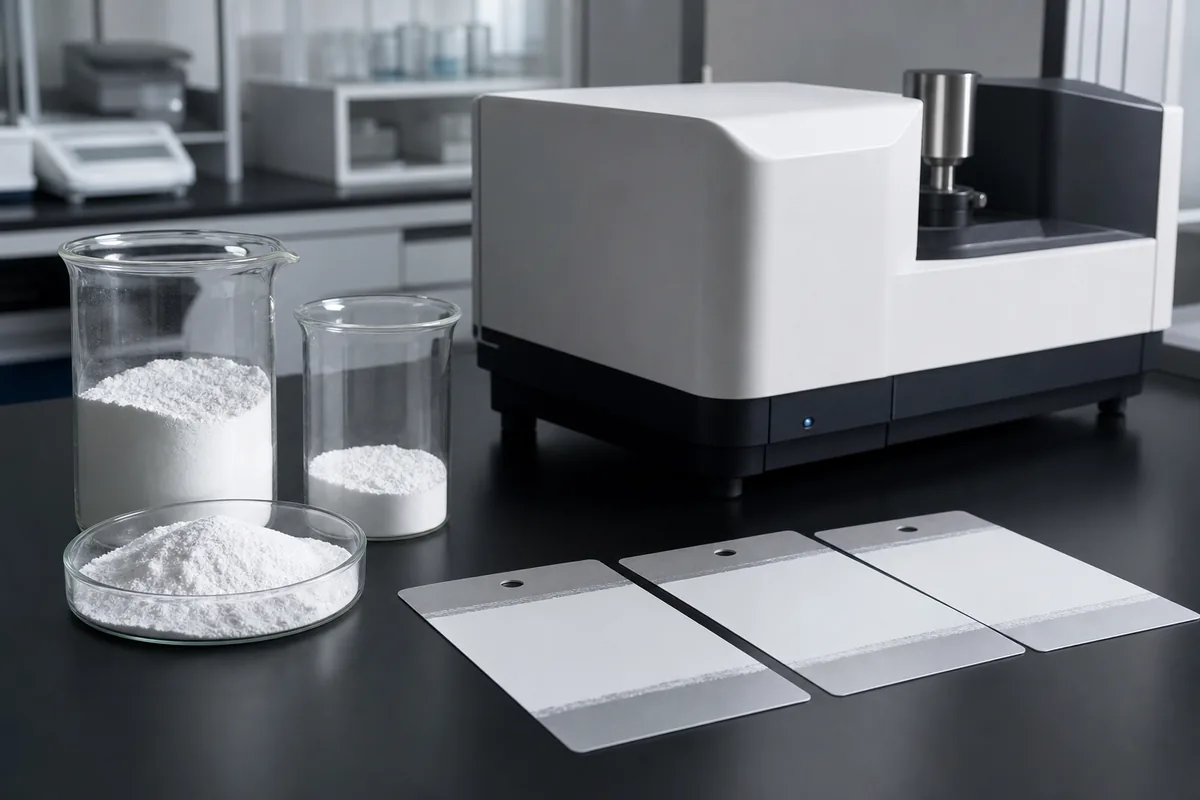
Choosing a matting agent for plastic coatings is harder than choosing one for wood. Plastic topcoats are often applied as very thin films, they must stick to low-energy substrates, and the brief usually specifies a feel as well as a gloss number. A grade that works in a 40 μm furniture lacquer can look rough, gritty or patchy at 15 μm on an ABS housing. This guide explains how silica matting works in thin plastic films, which parameters decide the grade, how to match grades to common plastic applications, and how to test a candidate before it reaches the production line.
It is written for formulators of waterborne coatings for consumer electronics, automotive interior trim, appliances and other plastic parts, and for buyers who need to understand why "the same" matting agent from two suppliers can behave differently on a thin film.
Why plastic coatings make matting harder
A silica matting agent lowers gloss by creating fine roughness at the film surface: as the coating dries and shrinks, the non-shrinking porous particles push up micro-bumps that scatter light. On plastic parts, several conditions make that mechanism harder to control:
- Thin dry films. Many plastic topcoats are applied at roughly 10–25 μm dry film thickness (DFT), and some are thinner still. When the particle size is large relative to the film, individual particles stand proud of the surface and show as texture, seeds or a sandy feel.
- Appearance and touch are both specified. Electronics and interior-trim customers judge the surface by hand as well as by gloss meter. Smoothness, soft-touch, fingerprint visibility and scratch marks are often part of acceptance.
- Adhesion comes first. Substrates such as PP, and to a lesser extent ABS and PC, need the right binder, primer or surface treatment. Silica loading raises the pigment volume of a clear film, and excessive loading can weaken cohesion and adhesion.
- Low gloss targets. Plastic parts are frequently specified in the deep-matte range, often single-digit gloss units at 60°, which pushes formulators toward higher loadings or coarser grades exactly where the film is thinnest.
- Waterborne film formation. In acrylic and polyurethane dispersions, drying rate, coalescent level and humidity all shift final gloss, and low application viscosity makes settling a constant concern.
The parameters that decide the grade
Most selection mistakes come from looking at one number on a datasheet. Compare these together:
| Parameter | What it controls on plastic | What to ask for |
|---|---|---|
| Particle size (d50) | Matting efficiency versus surface smoothness; must suit the DFT | d50 range, and a comparison against your target film build |
| Size distribution (d90, top cut) | Seeds, grit and haze from oversize particles in thin films | d90 or the full laser-diffraction curve, not d50 alone |
| Pore volume | Matting efficiency per gram; also viscosity build | Pore volume (mL/g) and oil absorption |
| Surface area | Interaction with binder and additives; rheology | BET surface area (m²/g) |
| Surface treatment | Hand-feel, scratch and burnish resistance, sediment type | Whether wax- or organically treated, and how sediment redisperses |
A practical rule used across the industry is to keep the particle size comfortably below the dry film thickness for smooth finishes, and to accept a coarser grade only when a textured or extreme low-gloss surface is wanted and the film is thick enough to hold it. The narrower the distribution, the closer to the film thickness you can work, because oversize particles are what cause visible defects.
Wax treatment is particularly useful on plastic. It tends to give a smoother, silkier feel, improves resistance to scratch and burnishing marks, and produces a soft, stir-back sediment rather than a hard cake in low-viscosity waterborne coatings.
Matching the matting agent for plastic coatings to the application
The table below is a starting-point map, based on general formulation practice. Every substrate, binder and spray line differs, so treat it as a shortlist for lab work, not a final answer.
| Application | Typical goal | Grade direction |
|---|---|---|
| Thin-film matte topcoats (around 10–15 μm) on housings and appliance parts | Matte without visible texture | Medium particle size with high matting efficiency and a narrow distribution |
| Premium consumer electronics (3C) and tactile surfaces | Deep matte with a fine, uniform, scratch-resistant feel | Wax-treated, medium-coarse grade designed for low gloss |
| Automotive interior trim | Very low gloss to reduce glare and reflections; scratch and rub resistance | Deep-matte grade; consider a coarser grade if the film build allows |
| Hard industrial plastic surfaces | Extreme low gloss; feel is secondary | Coarse, high-efficiency grade |
| Clear coats over printed or coloured plastics | Low gloss without greying the decoration | Fine, high-clarity grade with a narrow distribution |
| Soft-touch coatings | Velvety feel at low gloss | Fine to medium grade that complements the soft binder; avoid grit |
Formulation guidelines for matte plastic topcoats
- Fix the film build first. Agree the target DFT with the applicator before choosing a grade. A grade selected at 25 μm may look rough at 12 μm and glossy at 35 μm.
- Run a dosage ladder. Prepare the same base at, for example, 1%, 2%, 3% and 4% matting agent on total formulation and plot 60° and 85° gloss against loading. If the curve flattens before the target, switch to a more efficient grade rather than adding more silica.
- Watch viscosity on thin systems. Porous silica absorbs binder and water and builds viscosity. Overdosing to chase gloss is a common source of viscosity spikes and specks in thin plastic films; adjust with the rheology package, not by thinning the matting level away.
- Protect adhesion. Check cross-hatch adhesion (ISO 2409 or ASTM D3359) at the highest matting level you plan to use, on the real substrate and with its real pretreatment, because high silica loading can reduce adhesion.
- Balance coalescent and drying. Too much coalescent or slow, humid drying gives the binder time to flow over particles and raises gloss. Use the minimum needed for good film formation at your lowest line temperature.
- Use wax additives deliberately. Wax emulsions can improve scratch and mar resistance and help matting, but check recoatability and adhesion of any subsequent coats.
- Add slip and anti-fingerprint performance last. Silicone or wax additives change surface feel and fingerprint visibility; evaluate them after the matting level is settled so you are not chasing two variables at once.
Dispersion: wet, don't grind
Modern matting silicas are supplied already micronised, so the aim in production is to wet the powder and break up soft agglomerates without changing the particle size. Over-milling can reduce particle size and therefore matting efficiency.
- Charge water, dispersing additive and defoamer, then add the silica gradually under moderate stirring.
- Disperse on a high-speed disperser at a fixed speed and time, and keep both identical batch to batch; dispersion energy is a frequent cause of gloss variation.
- Check fineness on a Hegman gauge (ISO 1524 / ASTM D1210). For thin plastic films, no visible coarse particles above your film thickness is the practical requirement.
- Let down with binder at lower speed and add thickeners last. Filtering through a suitable mesh before spraying reduces seeds on cosmetic parts.
Lab test plan for a candidate grade
Before qualifying a grade, test it in your own base and on your own substrate. A compact plan:
- Gloss at 60° and 85° (ISO 2813 / ASTM D523) at the target DFT, plus one thinner and one thicker film to see how sensitive the gloss is to film build.
- Surface feel and appearance: compare by hand and under raking light against the current reference, looking for seeds, texture and patchiness.
- Adhesion by cross-hatch on each substrate, before and after any humidity or water-immersion test required by the specification.
- Scratch, mar and burnish: fingernail or stylus scratch, and a rub test with gloss measured before and after.
- Chemical and stain resistance to agents named by the end customer, such as hand cream, sunscreen or cleaning solutions.
- Storage stability: oven storage (40–50 °C for several weeks is a common choice), then check sediment type, viscosity and gloss drift.
If you are replacing a grade already in production, keep the loading identical in the first trial and compare side by side; our guide to replacing imported matting agents 1:1 covers a step-by-step qualification route for thin waterborne plastic coatings.
Where Censil1650A fits
For premium waterborne plastic coatings that need a deep-matte surface with a fine, uniform feel, Censil1650A is our lead grade. It is a wax-modified amorphous precipitated silica with a d50 of 6.2–6.5 μm, a pore volume of 1.6–1.8 mL/g and a surface area of 250–280 m²/g. It is designed to give a uniform, fine and scratch-resistant deep-matte surface rather than the coarse feel a larger particle would give, which is why we position it for consumer electronics, automotive trim and tactile furniture finishes.
- Dosage and dispersion: 1–4% on total formulation; high-speed dispersion for 15–20 minutes with no bead milling required.
- Benchmark: Censil1650A is benchmarked against ED 30 for low-gloss work; see the ED 30 alternative page.
- Thin general-purpose films: for matte plastic topcoats at around 10–15 μm, Censil361C (d50 5.9–6.2 μm) is usually the better first trial.
- Extreme low gloss on hard plastics: Censil3851 (d50 8.5–9.0 μm) is our coarsest grade, benchmarked against TS 100; see the TS 100 alternative page. Use it when gloss matters more than hand-feel.
- Supply: free 2 kg sample for lab trials, MOQ 500 kg, packed in 20 kg bags.
Specifications for all seven grades are on the products page, and the Premium Deep-Matte solution on the solutions page shows how Censil1650A pairs with supporting grades.