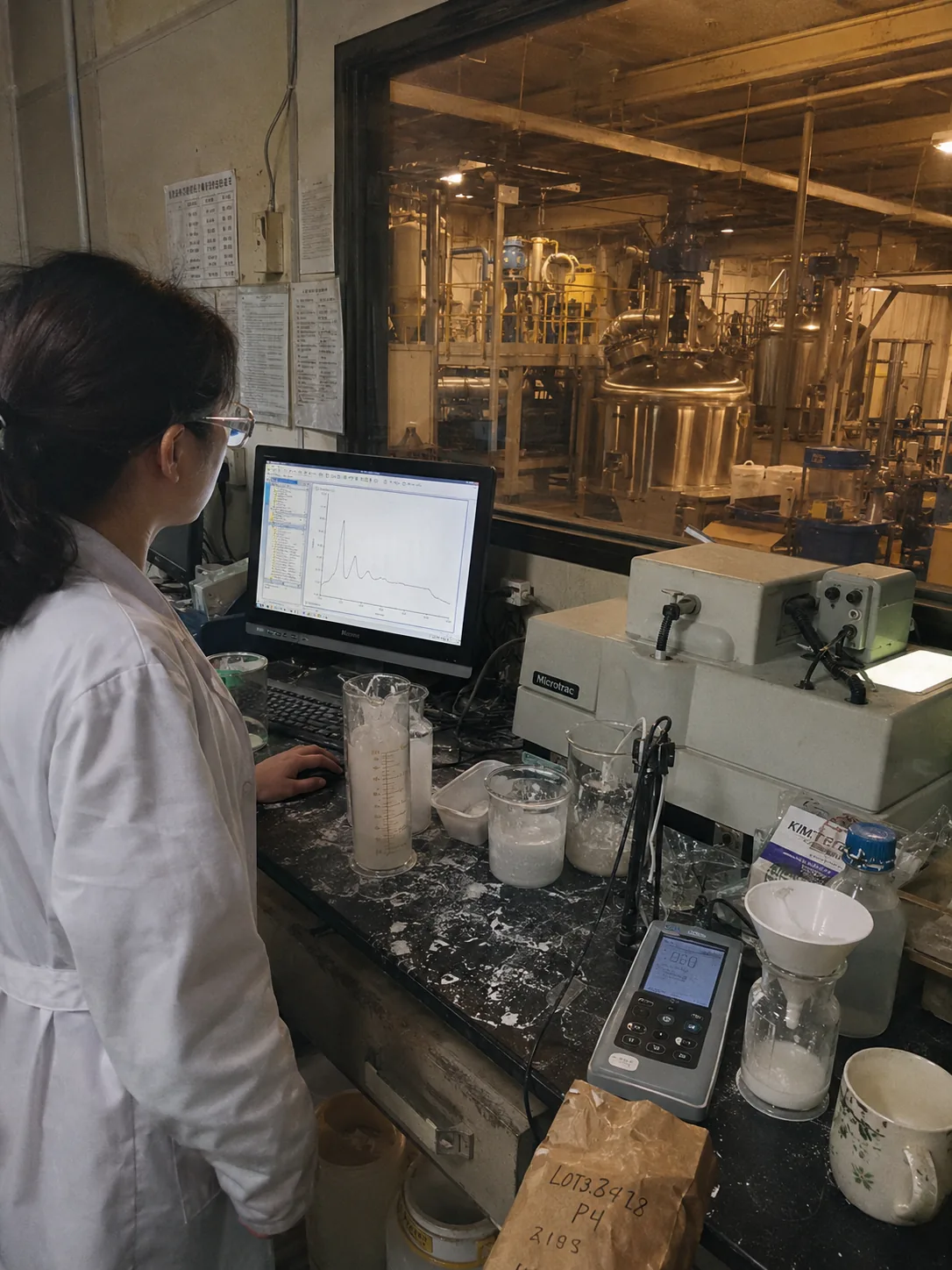
A silica matting agent is a fine, porous, synthetic amorphous silica powder that formulators add to a coating to lower its gloss. Once the film dries, the silica particles roughen the surface on a micrometre scale, so incoming light is scattered in many directions instead of being reflected like a mirror. The result is a satin, matte or dead-matte look, while a well-chosen grade keeps a clear coat transparent because silica's refractive index sits close to that of most binders.
This guide explains what the material is, the physics behind the gloss reduction, which datasheet parameters actually predict performance, how to add and test it, and where it fits in waterborne wood and plastic coatings. It is written for R&D chemists setting up a matte formulation and for buyers who need to understand what they are comparing between suppliers.
What a silica matting agent is (and what it isn't)
Commercial matting silicas are almost always synthetic amorphous silica (SiO₂). Two production routes dominate:
- Precipitated silica — made by reacting sodium silicate with acid in water, then filtering, washing, drying and milling. The process gives porous aggregates whose pore volume and particle size can be tuned. It is the workhorse of waterborne matting.
- Silica gel — made by forming a continuous gel that is then washed, dried and milled. Gels tend to have very regular porosity and are widely used in clear coats.
Both are milled and air-classified to a median particle size (d50) of a few micrometres. Many grades are then given a surface treatment — commonly a wax (for example polyethylene wax) or an organic coating — that improves soft settling, film feel and scratch resistance.
Two materials are often confused with matting silica. Fumed silica has nanometre-scale primary particles and is used mainly for rheology and anti-settling, not matting. Crystalline silica (quartz, cristobalite) is a different material with a different hazard profile; matting agents are amorphous. Our explainer on amorphous silica covers that distinction in detail.
How a silica matting agent works: the mechanism
Gloss is the fraction of light reflected at the specular angle. A smooth film reflects most light specularly and looks glossy. To make it look matte, you need surface irregularities large enough to scatter visible light — roughly in the range of a fraction of a micrometre up to a few micrometres in height.
1. Film shrinkage pushes particles to the surface
A wet film is mostly water or solvent plus binder. As the volatiles leave, the film shrinks dramatically in thickness. Silica particles do not shrink, so as the binder layer contracts around them, the particles end up forming bumps on the surface. The greater the shrinkage, the more pronounced the roughness — which is one reason waterborne systems, with relatively low solids and high shrinkage, generally matt efficiently.
2. Micro-roughness scatters light
Those bumps break up the specular reflection. Coarser particles create taller bumps and more scattering per particle, so they matt more efficiently, but they also make the surface feel rougher and can show as visible texture or "seeds" in thin films. Finer particles give a smoother touch and better clarity but need a higher loading for the same gloss.
3. Refractive-index matching keeps clears transparent
Amorphous silica has a refractive index of roughly 1.45–1.46, close to typical acrylic and polyurethane binders. Inside the film the particles are therefore nearly invisible. Haze in a matte clear usually comes from particles that are too large, too many, poorly dispersed, or surrounded by air or water voids — not from the silica itself.
4. Porosity sets the efficiency
Porous particles have a low apparent density, so one gram of a high-pore-volume silica contains many more particles than one gram of a dense filler. More particles per gram means more surface bumps per gram — higher matting efficiency at the same dosage. The trade-off is that porous particles absorb binder and water and can raise viscosity.
The parameters that predict performance
Most datasheets list the same handful of properties. The table summarises what each one tells you in practice.
| Parameter | What it controls | Practical reading |
|---|---|---|
| Particle size (d50) and distribution | Matting efficiency, clarity, surface feel, texture | Larger d50 = stronger matting, rougher feel. A narrow distribution (few oversize particles) helps clarity and avoids grit. |
| Pore volume | Particles per gram, matting efficiency, viscosity build | Higher pore volume usually means more efficient matting and more thickening. |
| Surface area (BET) | Interaction with binder, water and additives | Indicates how much surface is available to adsorb binder, surfactants and thickeners. |
| Surface treatment | Settling behaviour, scratch and burnish resistance, haptics | Wax-treated grades tend to form soft, stir-back sediment and give a smoother feel. |
| Oil absorption | Binder demand | Higher values mean the silica "takes" more binder; watch for viscosity and film properties at high loadings. |
| pH, moisture, SiO₂ content | Compatibility and batch consistency | Mostly QC parameters; check they stay within spec lot to lot. |
A useful rule of thumb from industry practice: match particle size to dry film thickness. Thin films (for example plastic coatings in the 10–25 μm range) usually need finer grades to avoid visible texture, while thicker wood topcoats can use coarser, more efficient grades. Our guide on how to choose a silica matting agent goes deeper into this selection logic.
Silica vs other matting technologies
Silica is not the only way to reduce gloss. Formulators often combine it with other materials, so it helps to know where each one fits.
| Technology | How it matts | Strengths | Limitations |
|---|---|---|---|
| Precipitated silica / silica gel | Surface micro-roughness from porous particles | Efficient, transparent in clears, wide gloss range | Can raise viscosity; untreated grades may settle hard |
| Wax matting additives | Wax migrates to surface and crystallises | Smooth feel, slip, scratch resistance | Limited matting power alone; can affect recoat adhesion |
| Polymer beads (e.g. PU, PMMA) | Spherical particles create surface relief | Soft-touch haptics, low burnish | Higher cost; lower efficiency per kg |
| Extender fillers (talc, carbonate) | Pigment volume effect, roughness | Low cost in pigmented paints | Not suitable for transparent clears |
In clear wood finishes and transparent plastic topcoats, silica is usually the primary matting agent because nothing else combines high efficiency with transparency. Wax or beads are added on top when the specification calls for a particular feel or burnish resistance.
How to add and disperse it
Matting silica is supplied already micronised. The job is to wet it and break up loose agglomerates, not to grind it further — heavy milling can reduce particle size and cut matting efficiency. A practical lab sequence:
- Charge water (and co-solvent if used) plus wetting/dispersing additive and defoamer.
- Add the silica slowly under moderate stirring to avoid dust and lumps.
- Disperse with a high-speed disperser (Censilcoat grades: 15–20 minutes, no bead mill required).
- Check fineness on a Hegman gauge (ISO 1524 / ASTM D1210) — you are looking for the absence of oversize agglomerates, not a "high" reading at any cost.
- Let down with the binder and remaining additives at lower speed; add thickeners last and adjust viscosity.
Alternatively, many plants prepare a silica pre-paste or slurry and post-add it, which makes gloss adjustment between batches easier.
Testing a matte formulation: a short checklist
- Gloss at 60° and 85° on a defined substrate and film thickness (ISO 2813 / ASTM D523). For low-gloss finishes, the 85° reading separates samples that look similar at 60°.
- Clarity — draw down over a black panel or dark wood and compare haze side by side with your reference.
- Viscosity before and after silica addition, and after 24 hours.
- Storage stability — oven storage (a common choice is 40–50 °C for several weeks), then check sediment type, re-dispersion and gloss drift.
- Surface resistance — burnish/rub, scratch and stain tests appropriate to the end use.
- Humidity sensitivity — for waterborne systems, apply and dry at high relative humidity to look for whitening.
The matting agent troubleshooting guide covers what to do when one of these checks fails.
Where Censilcoat grades fit
Censilcoat makes wax-modified amorphous precipitated silica matting agents for waterborne wood and plastic coatings. All seven grades share a pore volume of 1.6–1.8 mL/g and a surface area of 250–280 m²/g, are dosed at 1–4% on total formulation, and disperse with high-speed stirring in 15–20 minutes. The grades differ mainly in particle size and the job they are tuned for:
| Grade | d50 (μm) | Typical use | Benchmarked against |
|---|---|---|---|
| Censil660 | 5.0–5.3 | High-clarity, water-white clear topcoats; dark wood | ED 30 |
| Censil651 | 4.9–5.2 | Fine touch, smooth semi-matte and matte clears | ED 2 |
| Censil351C | 4.8–5.1 | Fine universal grade balancing appearance and stability | ED 3 |
| Censil361C | 5.9–6.2 | Universal semi-matte/matte workhorse, higher efficiency | ED 4, OK 412 |
| Censil1531D | 5.3–5.6 | Cost-optimised grade for first-round substitution | — |
| Censil1650A | 6.2–6.5 | Low-gloss deep matte for premium plastic coatings and tactile furniture | ED 30 |
| Censil3851 | 8.5–9.0 | Extreme low gloss on hard plastic surfaces | TS 100 |
Full specifications are on the products page, and the solutions page maps grades to resin system and gloss target. For trials, we ship a free 2 kg sample with a benchmark sheet; commercial orders start at an MOQ of 500 kg, packed in 20 kg bags.