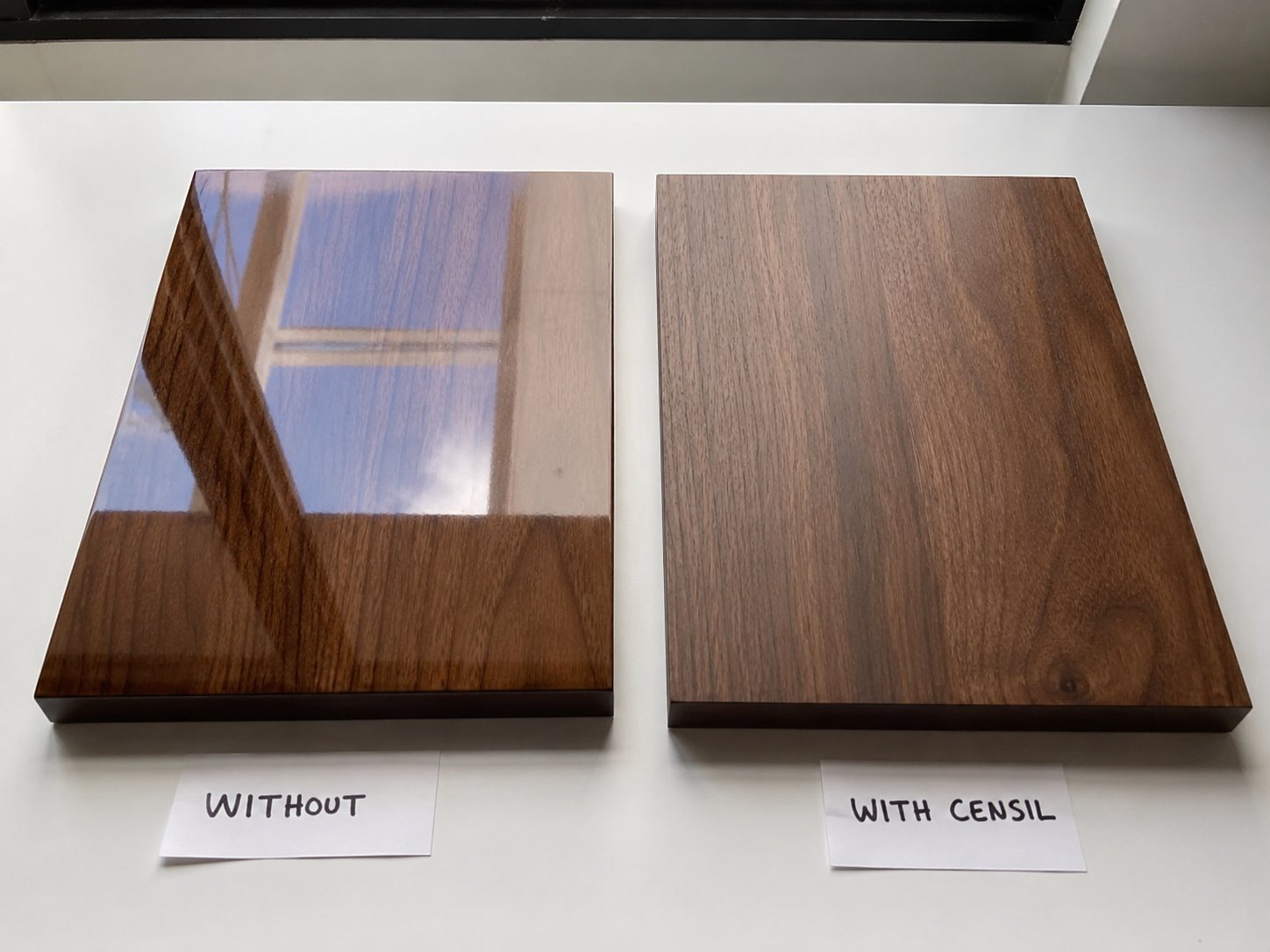
Gloss drift after storage is one of the most frustrating defects in matte coatings: a batch passes QC at release, then the same paint, opened weeks or months later, sprays a panel several gloss units higher or lower than the standard. In most cases the cause is not the gloss meter or the applicator but a slow change inside the can: the matting silica settles, agglomerates or interacts with the rheology package, or the binder and additives shift in ways that change how the film forms. This guide explains the common mechanisms, how to confirm the drift is real, a storage-stability test you can run in any lab, and the formulation fixes that usually work.
The focus is waterborne wood and plastic coatings matted with precipitated silica, but most of the logic applies to solvent-borne systems as well.
First, confirm the drift is real
Before reformulating, rule out measurement and application variables. Gloss on matte panels is very sensitive to film thickness, cure conditions and the way the sample was mixed. A surprising share of "storage" complaints turn out to be sampling problems. Check the following:
- Mixing before sampling. Was the can fully re-homogenised, including the bottom, before the panel was made? A sample poured from the top of a settled can will contain less matting agent and read glossier.
- Film thickness. Compare panels at the same wet and dry film thickness. In matte coatings, a thicker film usually reads glossier because more binder covers the silica particles at the surface.
- Cure and conditioning. Use the same drying temperature, humidity and airflow, and measure after the same conditioning time. Gloss can keep changing for several days as the film finishes coalescing.
- Substrate and geometry. Use the same substrate (sealed chart, glass or primed wood) and read at both 60° and 85°. Matte finishes often show differences at 85° that 60° misses. Our guide on how to measure gloss correctly on matte panels covers calibration and reading patterns.
- A fresh reference. Ideally compare the stored sample with a retained sample of the same batch that was stored cold, or with a freshly made batch from the same raw-material lots.
If the difference survives these checks, it is a genuine storage effect. The direction of the drift is your first diagnostic clue.
Why gloss rises after storage
Upward drift, where a matte coating becomes glossier, is the more common complaint. It means fewer effective matting particles are reaching the film surface, or the binder is covering them more completely.
1. Settling that is not fully stirred back
Precipitated silica has a higher density than water and most binders, so in low-viscosity waterborne coatings it settles over time. If the sediment is soft, a normal stir restores the original composition. If it packs into a hard layer, operators often leave part of it at the bottom of the drum, and the applied coating is effectively under-matted. Untreated silica in thin systems is especially prone to this; wax-treated grades usually form a softer, stir-back sediment. For the mechanism and fixes in detail, see eliminating hard sediment in waterborne coatings.
2. Changes in rheology and levelling
Porous silica keeps absorbing liquid after dispersion, and some thickeners continue to build structure for days. Viscosity changes during storage alter how the wet film flows out. A coating that levels more slowly can leave more silica at the surface; one that levels better or is thinned more heavily at the gun to reach application viscosity can bury particles, so gloss rises. Always compare application viscosity, not just the reading at release.
3. Additive migration and surface enrichment
Surfactants, defoamers, slip and wetting additives are mobile. Over storage they can redistribute between the water phase, the binder particles and the silica surface. Changes in what accumulates at the film surface during drying can increase surface smoothness and raise gloss, even though the silica content is unchanged.
Why gloss falls after storage
Downward drift is less common but usually more serious, because it tends to come with other visible defects.
4. Flocculation and agglomeration of the silica
Silica particles can re-associate during storage, especially when certain associative thickeners create depletion flocculation, or when ionic strength and pH change. Agglomerated silica produces a rougher surface and lower gloss, but often also seeds, a grainy feel and loss of clarity. A Hegman reading that has worsened since release is a strong sign of this mechanism.
5. Binder and pH changes
Many waterborne systems are neutralised with amines or ammonia, and pH can drift during storage as volatile neutraliser escapes through imperfect closures or as components slowly hydrolyse. A lower pH can reduce colloidal stability of both binder and silica, alter thickener efficiency, and change film formation. Coalescents can also partition into the binder particles over time, changing minimum film-forming behaviour. Depending on the system, these shifts can push gloss either way.
6. Temperature history
Warehouses in tropical climates can run very warm, and containers in transit can see large day–night swings. Heat accelerates every mechanism above: settling, thickener structure build-up, additive migration and neutraliser loss. Freeze–thaw exposure in cold climates can cause irreversible binder coagulation. If drift appears only in exported or summer-stored batches, temperature is a likely amplifier.
Diagnosing gloss drift after storage: quick table
| Observation | Likely mechanism | What to check |
|---|---|---|
| Gloss up; firm sediment at the bottom of the can | Settling not fully stirred back | Sediment hardness with a spatula; gloss of a fully re-homogenised sample |
| Gloss up; no sediment; viscosity changed | Rheology drift, thinning at application | Viscosity at release vs now; thinning ratio used at the gun |
| Gloss up; surface feels slicker | Additive migration to the surface | Recent changes in surfactant, defoamer or slip additive |
| Gloss down; seeds or worse Hegman | Silica flocculation or agglomeration | Fineness of gauge; thickener type and level |
| Gloss drift with pH change | Neutraliser loss or hydrolysis | pH at release vs now; container seal; neutraliser type |
| Drift only in hot-stored or exported lots | Temperature acceleration | Storage temperature records; heat-age test results |
A storage-stability test for matte coatings
The best way to prevent gloss drift after storage is to look for it before the product ships. A simple protocol, based on common industry practice, is below. Adapt the temperatures and durations to your own specifications and climate.
- Split one batch into several sealed containers: one stored cold as a reference, one at room temperature, and one in an oven for accelerated ageing (many labs use around 40–50 °C for two to four weeks, but follow your company standard).
- Record baseline values at release: viscosity, pH, fineness of grind, density, and 60°/85° gloss from a drawdown at a fixed film thickness.
- Inspect at intervals, for example after one, two and four weeks. Before opening, note any syneresis (clear layer on top). Then probe the bottom with a spatula and rate the sediment as none, soft or hard.
- Re-homogenise with a defined stirring procedure that mimics what customers actually do, not an aggressive lab disperser.
- Repeat the measurements and make new drawdowns under the same conditions as the baseline.
- Compare against tolerance. Set an acceptance window for gloss change at each geometry, plus limits for viscosity and pH. Matte specifications are often tight, so agree the tolerance with your customers or internal standard.
Run the test whenever you change the matting agent, thickener, binder or neutraliser, not only for new products. Gloss drift is often introduced by a small raw-material change that looked harmless at release.
Formulation fixes that prevent drift
| Lever | What to do | Why it helps |
|---|---|---|
| Matting agent surface treatment | Use a wax-treated silica in low-viscosity systems | Softer sediment that stirs back fully; less interaction with water-phase additives |
| Particle size | Choose the finest grade that meets the gloss target | Smaller particles settle more slowly; a larger d50 gives more matting per kilogram but settles faster |
| Anti-settling package | Build low-shear viscosity; a small amount of fumed silica or a suitable rheology additive can help | Slows particle settling without making the product hard to apply |
| Thickener choice | Screen associative thickeners for compatibility with the silica | Avoids depletion flocculation and agglomeration |
| Dispersion | Disperse fully at a defined tip speed and time | Under-dispersed agglomerates break down slowly in storage, shifting gloss |
| pH control | Use a low-volatility neutraliser or buffer; seal containers well | Keeps binder, thickener and silica stability constant |
| Process order | Add the silica at the stage specified, then let the batch equilibrate before final viscosity adjustment | Finishing viscosity after pore uptake reduces later drift |
Two practical notes. First, change one variable at a time and repeat the heat-age test: fixes for settling (more low-shear viscosity) can sometimes increase thickener interactions. Second, write the re-mixing procedure on the label or technical data sheet. Many field complaints are solved by telling users to stir from the bottom until no sediment remains.
How Censilcoat grades fit: Censil361C
For semi-matte and matte waterborne wood coatings, Censil361C is our universal workhorse grade. It is a wax-modified amorphous precipitated silica with a d50 of 5.9–6.2 μm, benchmarked against ED 4 and used as a replacement for OK 412. Its pore volume of 1.6–1.8 mL/g and surface area of 250–280 m²/g give high matting efficiency, so typical dosages sit in the 1–4% range on total formulation.
The surface treatment is relevant to storage drift. Censil grades are treated with a high-melt PE wax, which is designed to give a soft, stir-back sediment instead of a hard cake in low-viscosity waterborne systems. For long storage in very thin formulas, we can advise on pairing it with a small amount of fumed silica for anti-settling. Like all Censil grades, it disperses with high-speed stirring in 15–20 minutes, with no bead milling.
When evaluating Censil361C, run it side by side with your current matting agent through the storage-stability protocol above, at the same dosage and process. Benchmark data are on the ED 4 alternative and OK 412 alternative pages. Full specifications for all seven grades are on the products page, and the solutions page maps grades to resin system and gloss target. We ship in 20 kg bags with an MOQ of 500 kg, and a free 2 kg sample is available for lab trials.