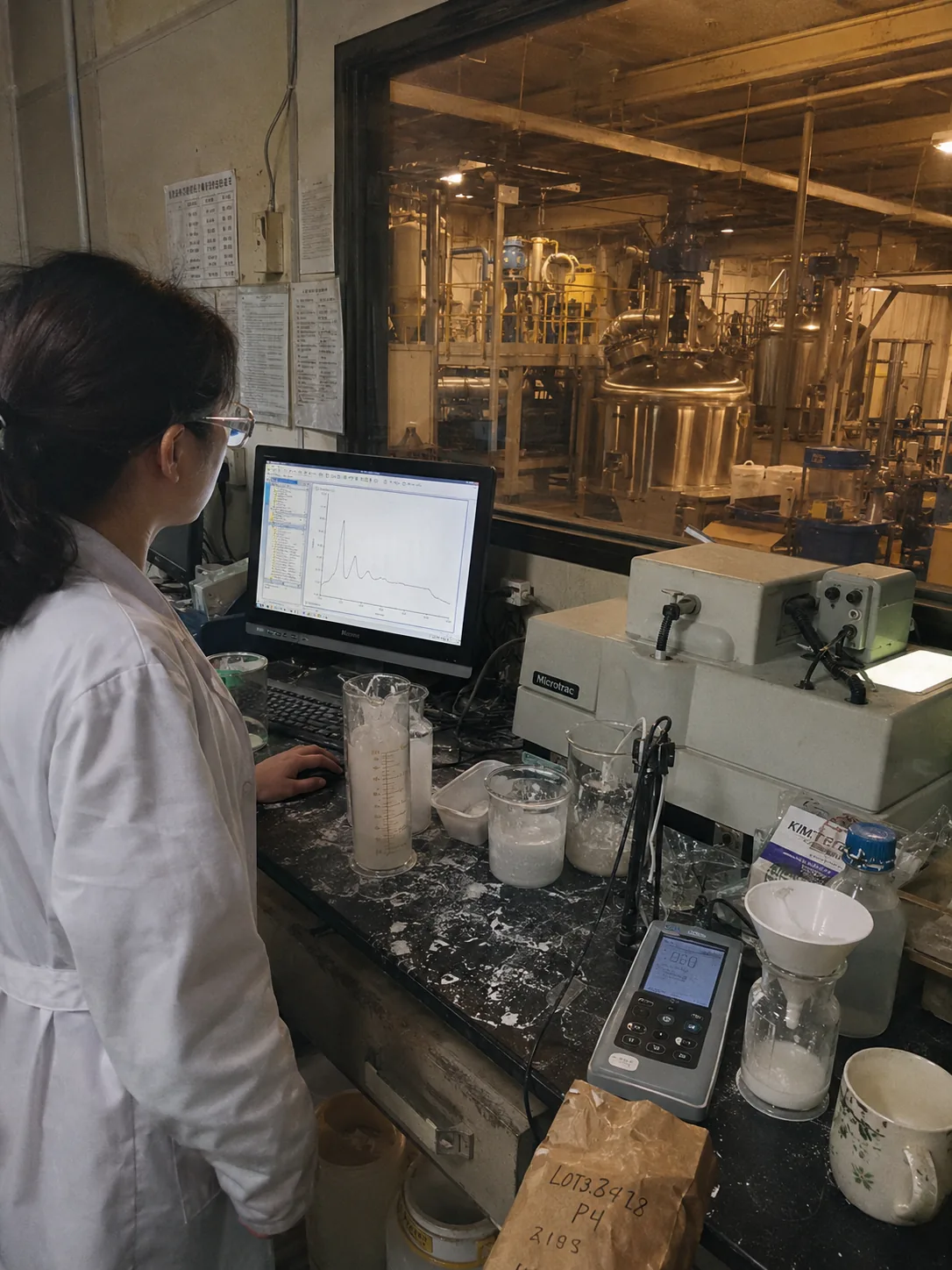
Finding an OK 412 replacement for waterborne wood coatings is less about finding a powder with the same name on the datasheet and more about proving, in your own formula, that a new grade gives the same gloss, clarity, feel and storage stability at the same dosage. The practical route is short: identify what OK 412 is doing in your system, choose a candidate with a similar particle size and a wax surface treatment, run both side by side at identical loading and dispersion, measure gloss at 60° and 85°, clarity over black, viscosity and can stability, and only then move to a production trial. This lab guide sets out that route step by step, with the parameters to compare, a test plan, acceptance criteria and the mistakes that most often derail a switch.
It is written for formulators who need the new grade to behave like the old one, and for procurement teams who need to know what a credible qualification looks like before they approve a second source.
Why labs look for an OK 412 replacement in waterborne coatings
OK 412 has long been a reference matting agent for semi-matte and matte wood finishes, and many waterborne formulas were originally built around it. The reasons to qualify an alternative are usually commercial rather than technical:
- Supply security. A single-source raw material is a risk. If one grade is delayed, the whole matte range can stop.
- Lead time and logistics. Long shipping routes and distributor stock levels make planning harder for plants in Asia, especially for small and medium volumes.
- Landed cost. Freight, duties and distributor margins stack on top of the ex-works price.
- Order size. Large minimum orders tie up working capital for plants that use a few hundred kilograms a month.
None of these justify a switch if the finish changes, which is why the replacement has to be qualified against the incumbent in the real formula.
What OK 412 does in a waterborne wood formula
OK 412 is a wax-treated precipitated silica in the medium particle size class, used mainly to reduce gloss in clear and pigmented wood coatings. In a waterborne film it does three jobs at once:
- Creates surface roughness. As water evaporates and the film shrinks, silica particles near the surface produce micro-roughness that scatters reflected light. Particle size and the amount of silica set how far gloss falls.
- Contributes to feel and burnish behaviour. The wax treatment affects slip and the smooth, dry touch of the cured film, and influences how easily the surface polishes up under rubbing.
- Influences storage behaviour. Surface treatment generally makes sediment softer and easier to stir back than with untreated silica, which matters in low-viscosity waterborne lacquers.
A replacement must cover all three jobs. Matching only the gloss at one dosage while ignoring feel or sediment is the most common reason a "successful" lab swap fails in the plant.
Parameters to compare before you open a sample
Start with the datasheets of the incumbent and the candidate, and ideally your own measurements of both. Datasheet values are produced by different methods at different suppliers, so treat them as a screening tool, not proof of equivalence.
| Parameter | What it controls | What to look for in a replacement |
|---|---|---|
| Particle size (d50) and distribution | Matting efficiency, clarity, surface feel, Hegman reading | Similar d50 and a narrow distribution with few coarse particles; coarse tails cause specks and haze |
| Pore volume / oil absorption | Matting efficiency per kg, viscosity build | Higher pore volume usually means more matting at the same dosage, but also more thickening |
| Surface area | Interaction with additives, rheology, wetting | Large differences mean the additive package may need a check |
| Surface treatment | Sediment, touch, slip, burnish resistance, humidity blushing | Wax-treated grade for a wax-treated incumbent; ask about wax type and melting range |
| pH and moisture | Compatibility with the binder, storage stability | Values within the range your formula already tolerates |
Do not expect every number to match. What matters is whether the gloss curve, clarity and stability overlap in your system. If the structural parameters are noticeably different, plan for a dosage fine-tune rather than a strict 1:1 swap.
Lab protocol: testing an OK 412 replacement side by side
Run the incumbent and the candidate in parallel, in the same base, on the same day, with the same equipment. Changing more than one variable at a time makes the results impossible to interpret.
- Fix the baseline. Use a current production batch of your formula, or a lab batch made exactly to the production recipe, as the base. Keep a retained panel from the approved production finish as the visual reference.
- Use the same addition point and dispersion. Add each matting agent at the same stage, typically after resin letdown under moderate shear, with the same disperser, blade, tip speed and time. Our guide to dispersing silica matting agents without bead milling covers practical settings.
- Build a dosage ladder. Make each grade at the incumbent's dosage and at least two steps either side, for example 1%, 2%, 3% and 4% on total formulation. A single point cannot show whether the two grades have the same matting efficiency.
- Check fineness and viscosity. Record the Hegman reading and viscosity of every sample after dispersion and again after 24 hours, using the viscometer and spindle your QC already uses.
- Apply at a controlled film build. Use the same drawdown bar or spray settings on the same substrate. Include sealed black charts for clarity and a real wood panel, ideally the species and stain your customer uses.
- Cure and measure at a fixed age. Measure gloss at 60° and 85° at an agreed time, for example 24 hours and 7 days. Our article on how to measure gloss correctly on matte panels explains why both angles matter.
- Check clarity and appearance. Compare drawdowns over black side by side, and look at the stained wood panels at a low angle. Grey cast or milkiness over dark wood is often the first difference you see.
- Run a heat-storage test. Store sealed samples at elevated temperature, commonly 7 days at 50 °C, then rate sediment (soft, stir-back or hard), viscosity change and gloss after re-application.
- Test humidity and feel. Apply panels at high relative humidity if your plant or customers see it, and compare blushing. Rate touch, slip and burnish resistance by hand and with a simple rub test.
Reading the results: when is a replacement "equivalent"?
Set acceptance criteria before you start, so the decision is not made on impressions. The table below is a starting framework; adjust the limits to your own specifications and measurement repeatability.
| Test | Suggested pass criterion | If it fails |
|---|---|---|
| Gloss at 60° and 85° | Within your production tolerance of the incumbent at the same dosage, or reached within a small dosage adjustment | Fine-tune dosage; if far off, try the next coarser or finer grade |
| Clarity over black | No visible difference, or better | Check for coarse particles, under-dispersion or wetting issues |
| Viscosity | Within your QC window; no extra thickener needed | Reduce dosage or rebalance thickener |
| Hegman fineness | Similar reading, no seeds | Extend dispersion time; check powder addition rate |
| Heat storage | Soft, stir-back sediment; gloss and viscosity stable | Review anti-settling package |
| Feel and burnish | Judged equal by the people who approve the finish | Discuss surface treatment options with the supplier |
If both gloss curves overlap across the ladder, the grades can usually be exchanged at the same dosage. If the candidate's curve sits slightly lower, it is more efficient and you may be able to use less. A difference of a few tenths of a percent in dosage is normal and easy to manage; a need for much more matting agent to reach the same gloss means the grade is not the right match.
Common mistakes when switching matting agents
- Testing at one dosage only. One matching gloss reading can hide very different curves. Always run a ladder.
- Changing dispersion at the same time. A faster blade or longer time for the new grade makes it look better or worse than it is.
- Comparing on different film builds. In matte films gloss usually rises with dry film thickness, so a thicker drawdown flatters neither grade.
- Measuring too early. Waterborne matte films can keep changing gloss for days. Compare at the same age, and recheck after storage.
- Ignoring additive interactions. A grade with higher surface area or pore volume can absorb wetting agent or interact with associative thickeners. If viscosity or clarity shifts, review the additive package before rejecting the grade.
- Skipping the production trial. Lab dispersers, spray lines and drying tunnels differ. A lab pass is necessary but not sufficient.
From lab pass to production: qualifying the second source
Once the candidate passes in the lab, move to a controlled plant trial. Make one production-size batch with the new grade, apply it on the normal line, and compare gloss, appearance and feel against a retained panel from a recent batch with the incumbent.
Before routine supply starts, agree a specification with the supplier: which properties appear on each certificate of analysis, the limits for each, and how they are measured. Ask for the TDS, SDS and a sample COA during the trial so your quality team can check that the documents fit your system. Many plants keep the incumbent grade as a dual source for the first few production cycles, then decide on volume split once batch-to-batch consistency of the new grade has been seen in practice.
How Censil361C fits as an OK 412 replacement
Censil361C is the Censilcoat grade positioned against OK 412 and ED 4: a wax-modified amorphous precipitated silica for waterborne semi-matte and matte wood and industrial coatings, described as the universal workhorse of the range with higher matting efficiency. Its published properties are:
| Property | Censil361C |
|---|---|
| Particle size d50 | 5.9–6.2 μm |
| Pore volume | 1.6–1.8 mL/g |
| Surface area | 250–280 m²/g |
| Surface treatment | High-melt PE wax |
| Recommended dosage | 1–4% on total formulation |
| Dispersion | High-speed stirring 15–20 min, no bead milling |
| Packing / MOQ | 20 kg bags; first orders from 500 kg |
Because its surface area and pore volume may differ from those of the grade you use today, treat the first trial as a side-by-side ladder rather than assuming identical numbers, and fine-tune dosage if the gloss curve sits lower. The OK 412 alternative page sets out our own parallel lab comparison and its method notes; the same grade is also benchmarked against ED 4. If your finish needs more clarity over dark wood, Censil660 or Censil651 are the usual next candidates; for deeper matte, Censil1650A. All grades are listed on the products page, and the solutions page maps them to resin system and gloss target.