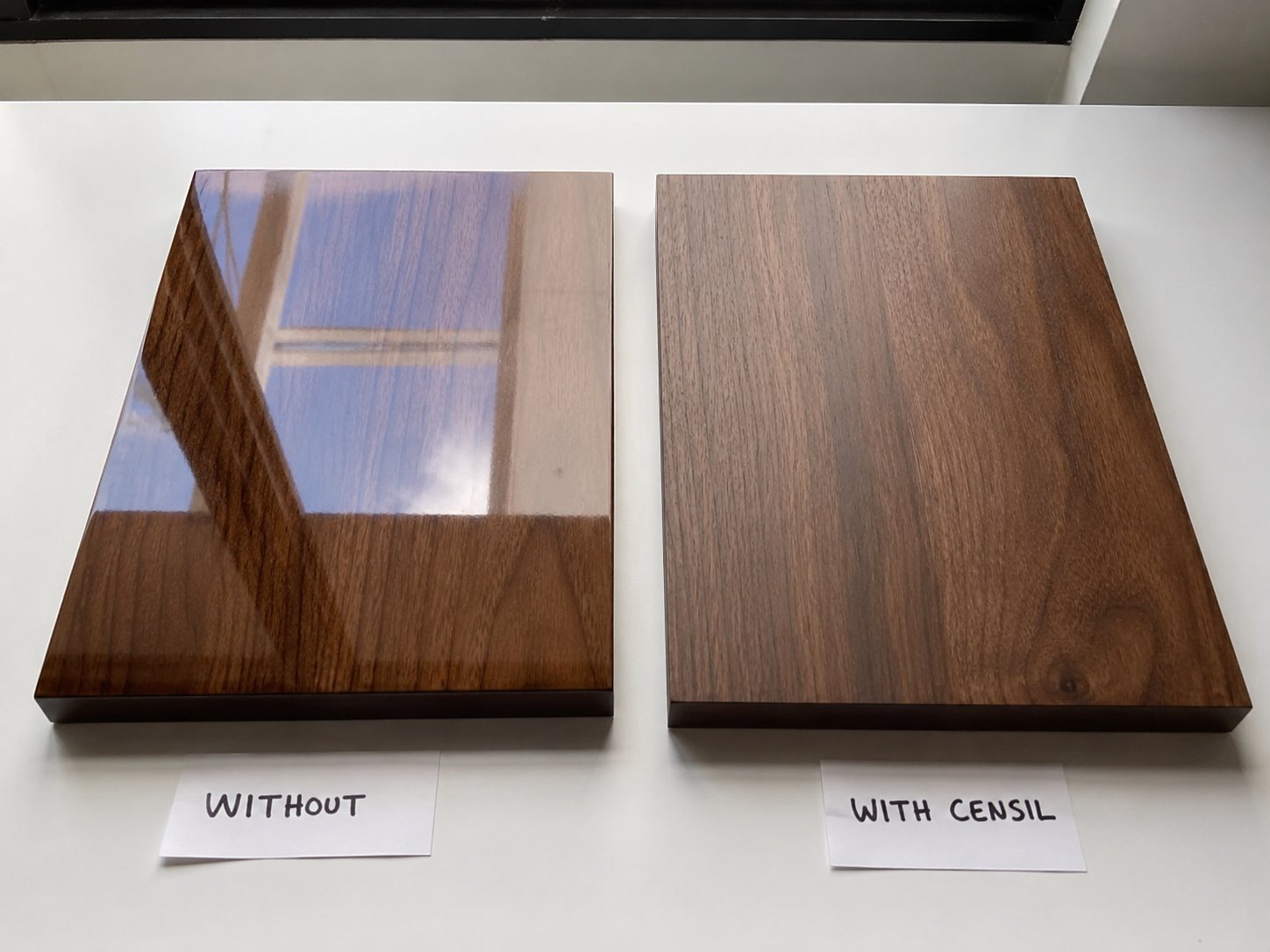
A true waterborne matte wood finish is one that reads low-gloss from every viewing angle, stays clear over the grain, feels smooth and keeps its sheen after rubbing, storage and months of use. Getting there with a water-based system takes more than adding extra silica: the matting agent's particle size, the dry film thickness, the binder, the dispersion step and the drying conditions all move the final gloss. This guide walks through each of those levers, with practical ranges, a test checklist and a troubleshooting table for when the panel still looks too shiny, too grey or patchy.
It is written for formulators developing waterborne furniture, cabinet, door and flooring topcoats, and for technical buyers who need to understand why two "matte" products from different suppliers behave so differently on the line.
What "true matte" means for a waterborne wood finish
There is no single global definition of matte. Brands and furniture makers set their own gloss bands, usually measured at 60° according to ISO 2813 or ASTM D523. The working bands below are common in the wood-coatings industry, but always confirm the target and geometry with the customer's specification.
| Description | Typical 60° gloss (GU) | What to watch |
|---|---|---|
| Dead matte / full matte | Below about 10 | Clarity loss, rough feel, burnishing, high silica load |
| Matte | About 10–20 | Sheen at low viewing angles, gloss drift in storage |
| Semi-matte / satin | About 20–40 | Patchy sheen, sensitivity to film thickness |
| Semi-gloss | About 40–70 | Usually achieved with low silica loadings |
The word "true" matters because many finishes hit their 60° number but still look shiny when you view a tabletop at a low angle. That is "sheen", and it is measured at 85°. A finish that reads well under 10 GU at 60° can still give a much higher 85° reading if the surface roughness is not fine and uniform enough. For matte wood finishes, specify and report both angles.
Why waterborne wood coatings are harder to matt
Silica matts a film because the binder shrinks around non-shrinking particles as water leaves, leaving micro-bumps on the surface that scatter light. (Our explainer on how a silica matting agent works covers the mechanism in detail.) Waterborne wood coatings add some complications:
- Film formation by coalescence. Acrylic and polyurethane dispersions form a film when polymer particles pack and fuse. If coalescence is slow or incomplete, the surface stays mobile longer and silica particles can be wetted over by binder, which raises gloss.
- Drying speed varies with humidity. Water evaporation slows sharply at high relative humidity. Slower, uneven drying gives more time for levelling and for particles to sink away from the surface, so gloss can differ between a dry winter line and a humid summer line. High humidity can also cause whitening; see whitening in waterborne matte coatings.
- Low viscosity in the can. Spray-viscosity waterborne topcoats give dense particles an easy path to settle. Untreated silica can form a hard sediment that is never fully redispersed, so the applied coating contains less effective matting agent than the formula says.
- Clarity expectations. Wood finishes are mostly clear. Extra silica or coarse particles that would be invisible in a pigmented paint show up as a grey veil over dark timber.
Choosing the right silica matting agent
The silica grade sets the ceiling for what the rest of the formulation can achieve. Four properties do most of the work:
- Particle size (d50) relative to dry film thickness. Coarser particles create taller surface bumps and matt more efficiently, but too large a particle relative to film build shows as texture and grit. Wood topcoats typically run thicker than plastic coatings, so medium grades around 5–7 μm are a common starting point for furniture and cabinet topcoats.
- Particle size distribution. A narrow distribution with few oversize particles keeps clarity and avoids "seeds". Ask suppliers for d90 or a full distribution curve, not only d50.
- Pore volume. Higher pore volume means more particles per gram and better matting efficiency, at the price of more viscosity build and binder demand.
- Surface treatment. Wax-treated grades generally give softer, stir-back sediment, a smoother hand-feel and better resistance to burnishing than untreated grades.
| Particle size class | Matting efficiency | Clarity and feel | Typical role in wood coatings |
|---|---|---|---|
| Fine (about 4–5 μm) | Moderate; more needed for low gloss | High clarity, very smooth | High-clarity clears, thin films, soft-touch |
| Medium (about 5–7 μm) | Good | Good balance | Universal semi-matte and matte topcoats |
| Coarse (above about 7 μm) | High | Rougher feel, more risk of haze | Dead matte at higher film builds, special effects |
For a structured approach to grade selection, see how to choose a silica matting agent.
Formulation levers beyond the silica
When a panel is still too glossy, adding more silica is the first reflex and often the wrong one. Check these levers first:
- Run a dosage ladder, don't guess. Make the same base with, for example, 1%, 2%, 3% and 4% matting agent on total formulation and plot 60° and 85° gloss against dosage. The curve flattens at higher loadings; past that point, more silica mainly costs clarity and viscosity.
- Binder hardness and minimum film-forming temperature. Softer, slower-coalescing binders tend to flow over particles and give higher gloss at the same dosage than harder binders. If you change the binder blend, re-run the gloss curve.
- Coalescent and co-solvent level. Extra coalescent lengthens the open time and can raise gloss. Use the minimum needed for good film formation at your lowest application temperature.
- Rheology package. Some associative thickeners interact with silica surfaces and change viscosity or stability over time. Test viscosity at 24 hours and after oven storage, not only immediately.
- Wax and slip additives. Wax emulsions can support matting and improve burnish and scratch resistance, but they can also affect recoat adhesion. Check intercoat adhesion if the topcoat will be sanded and recoated.
- Solids and film build. Matting depends on how much the film shrinks and on the final dry film thickness. A higher-solids version of the same formula, or a thicker applied coat, often comes out glossier.
Dispersion and process: get the silica working
Modern matting silicas arrive already micronised. The job in the plant is to wet the powder and break up loose agglomerates, not to grind it. Over-milling can reduce particle size and lower matting efficiency.
- Charge water, dispersing additive and defoamer, then add the silica slowly under moderate stirring to avoid lumps and dust.
- Disperse on a high-speed disperser for a fixed time and speed, and keep both the same between batches; changing dispersion energy is a common cause of batch-to-batch gloss variation.
- Check fineness on a Hegman gauge (ISO 1524 / ASTM D1210) to confirm there are no oversize agglomerates.
- Let down with binder at lower speed and add thickeners last.
- Many plants make a silica pre-paste or slurry and post-add it, which makes final gloss adjustment easier.
Application and drying: where matte finishes are won or lost
The same coating can measure very differently depending on how it is applied. Points to standardise on the line:
- Dry film thickness per coat. Keep it within the range you used in the lab. Heavy coats generally give higher gloss and more haze.
- Matte only where it is needed. In a sealer-plus-topcoat system, the topcoat controls the final gloss. Heavily matting the sealer adds haze under the topcoat without much benefit; many finishers use a lightly matted or unmatted sealer and a fully matted topcoat.
- Drying conditions. Temperature, airflow and humidity in the flash-off zone and drying room all shift gloss. Record them alongside gloss readings so you can separate formulation effects from process effects.
- Spray settings. Atomisation, fluid pressure and gun distance influence film build and surface uniformity. Patchy sheen on large panels often traces back to uneven overlap rather than the coating.
Testing checklist for a waterborne matte wood finish
- Gloss at 60° and 85° on a defined substrate, film thickness and drying schedule.
- Clarity over a black panel and over dark wood such as walnut, compared side by side with the reference.
- Burnish and rub resistance: rub with a cloth or abrasive pad and measure the gloss increase.
- Storage stability: oven storage (a common choice is 40–50 °C for several weeks), then check sediment type, redispersion, viscosity and gloss drift.
- Humidity sensitivity: apply and dry at high relative humidity and look for whitening.
- Feel and scratch as required by the end use (fingernail marks, writing effect, stain resistance).
Quick troubleshooting table
| Symptom | Likely causes | First things to try |
|---|---|---|
| Gloss too high at 60° | Grade too fine, under-dosed, thick film, soft binder, slow drying | Run dosage ladder; try a medium grade; check DFT and drying conditions |
| OK at 60° but shiny at low angles | Surface roughness too fine or uneven | Measure 85°; try a slightly coarser or more efficient grade rather than more of a fine one |
| Grey haze on dark wood | Overdosing, coarse or wide-distribution silica, agglomerates, matted sealer | Switch to a narrow-distribution grade; reduce sealer matting; check Hegman |
| Gloss rises after rubbing | Burnishing of exposed particles | Wax-treated silica, wax additive, harder binder |
| Gloss changes after storage | Hard settling, silica–thickener interaction, binder change | Wax-treated grade; review thickener; run oven storage test |
For more failure modes and their mechanisms, see the matting agent troubleshooting guide.
Where Censil361C fits
For most semi-matte to matte waterborne wood topcoats, Censil361C is our universal starting grade. It is a wax-modified amorphous precipitated silica with a d50 of 5.9–6.2 μm, a pore volume of 1.6–1.8 mL/g and a surface area of 250–280 m²/g. The slightly coarser particle size gives higher matting efficiency than our fine grades, so many formulations reach their gloss target within the 1–4% dosage range on total formulation.
- Dispersion: high-speed dispersion for 15–20 minutes; no bead milling required.
- Benchmarks: Censil361C is benchmarked 1:1 against ED 4 and OK 412 — see the ED 4 alternative and OK 412 alternative pages.
- When to choose another grade: for water-white clears over dark solid wood, start with Censil660 (see matte without haze on dark wood); for tactile, deep-matte furniture surfaces, look at Censil1650A.
- Supply: free 2 kg sample for lab trials, MOQ 500 kg, packed in 20 kg bags.
Full specifications for all seven grades are on the products page, and the solutions page maps grades to resin systems and gloss targets.