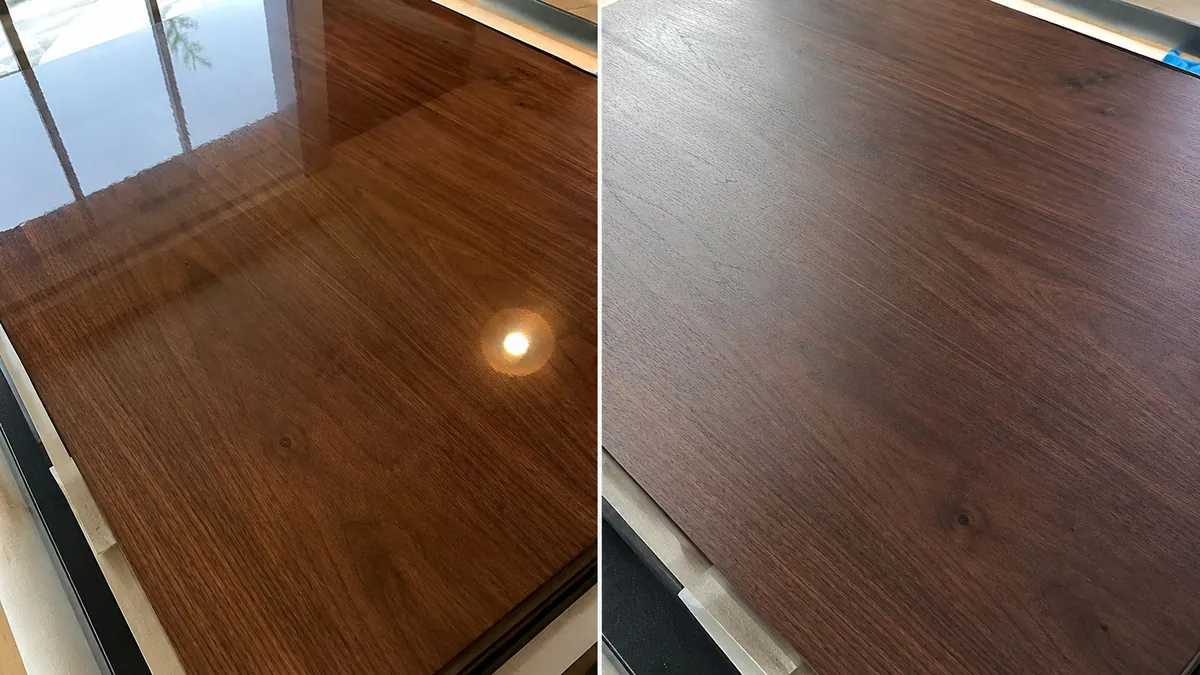
In a lab conditioned to 25 °C and 50% relative humidity, a waterborne matte topcoat can look flawless — clear, even, the target gloss dead-on. Move the same formula to a production line in Ho Chi Minh City or Johor in the wet season, at 85–90% relative humidity, and a milky bloom can appear across the film within hours. Nothing in the can changed. What changed is the physics of how the film formed. This article separates the two mechanisms responsible, gives a test that tells them apart, and lists the fixes in the order a formulator should try them.
1. How a waterborne film is supposed to form
A waterborne coating dries in three overlapping stages. First, water evaporates and the latex particles pack together. Second, once the temperature is above the polymer's minimum film-formation temperature (MFFT) and with the help of a coalescing aid, the packed particles deform from spheres and press into a continuous layer. Third, polymer chains interdiffuse across the old particle boundaries — true coalescence — giving the film its final clarity, hardness and moisture resistance. A film that completes all three stages is optically continuous, so it looks clear. A film that stalls at stage one or two stays full of sub-micron voids, and voids scatter light.
2. Mechanism A — blushing from incomplete coalescence
High humidity attacks stage two and three directly. When relative humidity climbs above about 80%, or the substrate sits near or below the dew point, water evaporates so slowly that the more volatile coalescing aid can leave the film first. Without enough coalescent present at the moment the particles need to deform, they never fully fuse. The result is a porous, incompletely coalesced film — mechanically weaker and optically hazy. This is classic blushing: a milky cast that is often partly reversible once the film finally dries or is reconditioned at lower humidity. Industry film-formation guidance is consistent on the threshold — keep relative humidity below 80%, ideally 40–60%, for clean film formation — which is precisely the window a tropical plant cannot hold for much of the year.
3. Mechanism B — scatter from the matting agent
The second mechanism is specific to matte coatings and is the one buyers most often blame on "a bad batch of silica." A matting agent works by roughening the film surface at a microscopic scale so that light reflects diffusely instead of specularly — that is what lowers gloss. But the same particle is a porous silica body with a refractive index (~1.45) different from the cured binder. Three things turn that useful scatter into unwanted whitening:
- Moisture in the pores. A hydrophilic, untreated silica draws water into its internal pore volume. Water sitting in and around the particle increases the refractive-index mismatch and the scatter, reading as a whitish or grey haze — worst on dark substrates where there is little reflected color to mask it.
- A porous film around the particle. If Mechanism A has left voids, those voids cluster around the relatively large silica particles, compounding the scatter.
- Over-dosing. Pushing loading to hit a low gloss target raises the volume fraction of scattering silica and can itself increase whitening and lower film integrity.
This whitening tends to be permanent, because it is built into the cured film's structure rather than being transient trapped water.
4. Diagnosis: which mechanism do you have?
The two mechanisms call for different fixes, so identify them before changing anything. The fastest discriminator is a recovery test on a dark panel.
| Observation | Points to | First lever to pull |
|---|---|---|
| Milky cast clears as the film fully dries / is reconditioned at 50% RH | Mechanism A (blushing / trapped moisture, incomplete coalescence) | Coalescent package, dew-point margin, film thickness |
| Whitish or grey cast is permanent, strongest on dark wood | Mechanism B (silica scatter) — often on top of A | Switch to a wax-modified hydrophobic grade; check loading |
| Appears only above ~80% RH, both mechanisms | Combined — typical tropical failure | Fix process window first, then material |
| Hard, gritty sediment in the can before application | Related dispersion problem, not humidity | See our troubleshooting guide |
5. The fixes, in order
Process first — it is free
- Hold a dew-point margin. Keep substrate temperature several degrees above the dew point and, where possible, cap booth humidity below 80%. Dehumidification in the flash-off zone often solves borderline cases outright.
- Do not over-apply. Thicker wet films trap water longer; apply at the specified wet-film thickness rather than building gloss down with extra material.
- Give it flash time. Extend flash-off before force-drying so water can leave before the surface skins over.
Formulation second
- Match the coalescent to the humidity. Choose a coalescing aid whose evaporation profile keeps it in the film until the particles have deformed; slower, less water-sensitive coalescents help at high RH.
- Balance the defoamer and wetting package so entrained air is not adding its own scatter.
- Right-size the matting loading to the gloss target rather than over-dosing a low-efficiency grade.
Material third — the matting agent itself
When process and formulation are sound and whitening on dark substrates persists, the matting agent is the variable. The properties that resist high-humidity whitening are:
| Property | Why it helps against whitening |
|---|---|
| Wax-modified / hydrophobic surface treatment | Takes up less water into the pore structure, cutting moisture-driven scatter and improving dispersion |
| Controlled pore volume (≈1.6–1.8 mL/g) | Enough structure for efficient matting without excessive water-holding voids |
| Narrow particle-size distribution | Predictable gloss at lower loading, so less scattering silica in the film |
| Soft, re-stirrable sediment (high-melt PE-wax treatment) | Stable in low-viscosity waterborne systems without hard caking that forces re-work |
This is the design brief behind the Censilcoat range: wax-modified amorphous precipitated silica, pore volume 1.6–1.8 mL/g and surface area 250–280 m²/g across the line, with grades benchmarked 1:1 against the imported grades most tropical plants already run. For high-clarity water-white clears on dark solid wood — the hardest whitening case — Censil660 (d50 5.0–5.3 μm, benchmarked to Grace SYLOID® ED 30) is the lead grade; for universal semi-matte to matte work, Censil361C (d50 5.9–6.2 μm, benchmarked to SYLOID® ED 4). Full parameters are on the products page.
6. A test that actually predicts the field
Datasheets are generated at 50% RH and will not tell you how a grade behaves at 85%. Before qualifying any matting agent for tropical service, reproduce the failure deliberately:
- Draw down incumbent and candidate side by side on the same dark substrate at identical wet-film thickness.
- Flash and cure both in a chamber at 85% RH, 25 °C — the worst-case window, not lab standard.
- Record 60° gloss and, if you can, L* or transmission haze on the dark panel.
- Expose to condensing humidity for 24 h, then recondition at 50% RH and re-read. Reversible whitening = trapped moisture (Mechanism A); permanent whitening = porous film or silica scatter (Mechanism B).
- Rank candidate vs. incumbent on onset RH, severity and recovery. Only that panel result qualifies a grade.
Summary
Whitening in waterborne mattes at high humidity is not one problem but two that arrive together: a coalescence failure that makes the whole film porous, and light scatter from a moisture-loaded matting silica. Fix the process window first, the coalescent package second, and treat the matting agent as the deciding variable when whitening persists on dark substrates. A wax-modified, humidity-tolerant silica with controlled pore volume is engineered for exactly this environment.
For the adjacent lab work, see our guides on choosing a matting agent, running a 1:1 replacement and the broader troubleshooting guide. To test a benchmarked, humidity-tolerant grade on your own system, a free 2 kg sample ships with a parameter-matched comparison sheet, TDS, SDS.