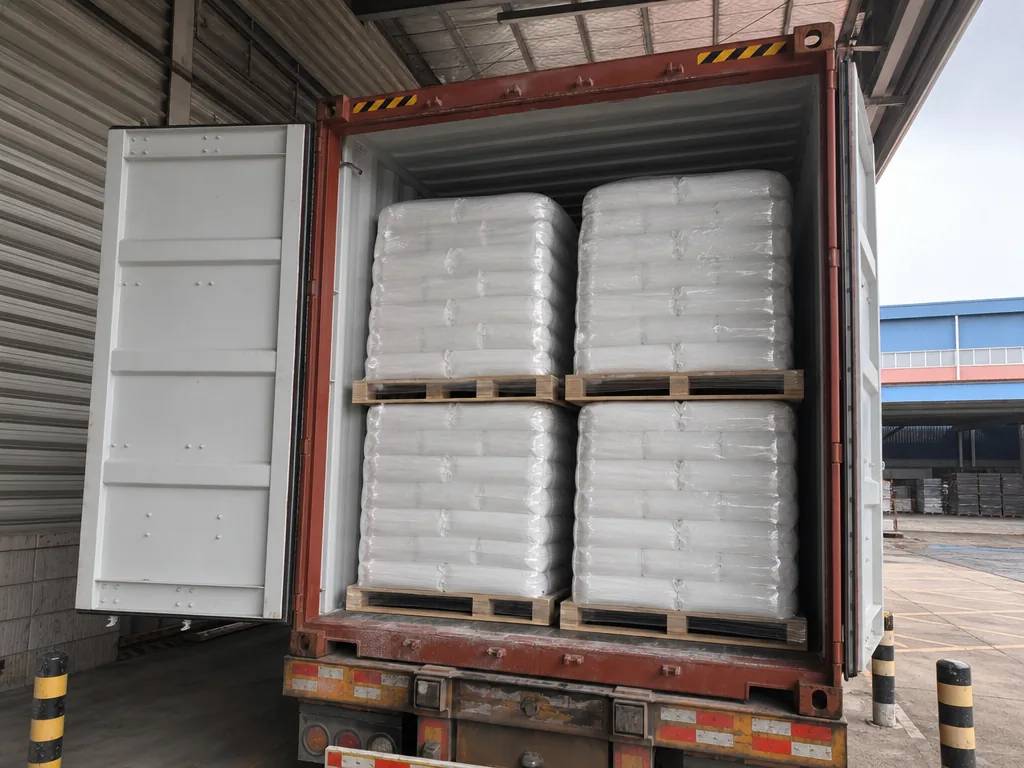
Ask a purchasing manager at a Vietnamese wood-coating plant what changed between 2021 and 2026, and the answer is rarely about chemistry. The product in the bag — precipitated amorphous silica, wax-treated, milled to a tight particle-size band — has evolved slowly. What has changed is everything around it: freight economics, currency exposure, the cost base of European additive production, and the regulatory push toward waterborne systems. Together, these forces are quietly rewriting sourcing strategy for one of the smallest line items in a coating formula.
1. Freight: normalized, but geography still wins
The container-rate spikes of 2021–2022 are history, but their lesson stuck: a supply chain that crosses two oceans carries risk that no unit price offsets. For Southeast Asian buyers, the structural facts have not moved. A pallet shipped from a Chinese port reaches Haiphong, Ho Chi Minh City or Port Klang in roughly three to seven days; the same order routed from a European warehouse typically spends four to eight weeks in transit and passes through more hands, each adding cost and schedule variance. When humidity-sensitive production windows and monthly consumption of a few tons are involved, transit variance — not just the freight bill — is the real cost.
2. The European cost base is not coming back down
European chemical producers have spent three years absorbing elevated energy costs, tightening environmental compliance and, in several segments, rationalizing capacity. None of that is scandalous — it is structural. But it means the price umbrella held over premium additive brands is unlikely to fold. Price-reporting services such as ICIS, which track chemical supply and pricing across regions, have documented the broader pattern for European commodity and specialty chemicals: the cost floor moved up, and buyers should not plan around a return to pre-2021 economics. For an additive dosed at one to four percent of a formula, the temptation is to ignore this. Plants running hundreds of tons of paint per month have stopped ignoring it.
3. The waterborne shift is the real demand driver
The most important trend has nothing to do with logistics. Across Vietnam, Thailand and Malaysia, furniture exporters and industrial coaters are moving from solventborne to waterborne systems — pushed by customer ESG requirements, tightening VOC expectations in export markets, and the simple fact that waterborne technology has closed most of the performance gap. Matting a waterborne film is harder than matting a solventborne one: lower binder solids, coalescence-driven film formation, and tropical humidity all conspire against a clean matte finish. That shifts demand toward matting agents engineered specifically for waterborne systems — narrow particle-size distribution, humidity-tolerant surface treatment — and away from general-purpose grades.
4. Regional alternatives grew up
Five years ago, "local alternative" usually meant a cost compromise: acceptable matting efficiency, but haze on dark substrates, sedimentation in storage, or batch-to-batch drift. That generation is passing. The credible regional producers now publish full physicochemical data — d50, pore volume, surface area, surface treatment — and position specific grades against specific imported benchmarks rather than selling a generic powder. The qualification conversation has changed accordingly: instead of "is there a cheaper powder," the question formulators now ask is "which grade matches my benchmark parameter-for-parameter, and what does the humidity cabinet say."
What a rational 2026 sourcing strategy looks like
| Step | Action | Why it matters |
|---|---|---|
| 1 | Map your benchmark grades to their published parameters (d50, pore volume, surface area, treatment) | Parameter matching is the only honest starting point for a 1:1 replacement |
| 2 | Run a paired lab trial: same formula, same substrate, candidate vs. incumbent | Datasheets do not capture haze on dark wood or behavior at 85% RH — panels do |
| 3 | Stress the humidity case specifically | Whitening under high humidity is the number-one field failure for matte waterborne coatings in the region |
| 4 | Qualify a second source before you need it | Dual qualification is what converts market knowledge into negotiating leverage |
| 5 | Watch landed cost, not bag price | Freight, duty, payment terms and inventory carrying cost routinely move the real number by double digits |
Where this leaves buyers
None of the four forces above is dramatic on its own. Together they explain why 2026 procurement behavior looks different: more parallel qualification trials, more insistence on full parameter disclosure, more weight on delivery time and less on brand inertia. The plants that treat matting agents as a strategic dual-sourced input — rather than a legacy line item — are the ones entering price negotiations with alternatives already validated on their own line.
For formulators starting that process, our guides on selecting a silica matting agent and running a 1:1 replacement trial cover the lab protocol in detail. And if you want to test a benchmarked alternative on your own system, a free 2 kg sample ships with a parameter-matched comparison sheet.