Ask a purchasing manager in Vietnam or Malaysia which imported matting agent their plant standardised on, and the answer is almost always one of two names: Evonik’s ACEMATT® OK 412 or Grace’s SYLOID® ED 30. Both are excellent products. But when a formulator tries to compare them on paper, the exercise collapses immediately — the two manufacturers publish different parameters, measured by different methods, in different units. This article reports what we found when we removed that problem: one laboratory, one method set, one waterborne system, both grades bought on the open market and run in parallel.
1. Why the datasheets cannot be compared
Three examples make the point. Oil absorption is published in DOA (dioctyl adipate) for OK 412 but in DBP (dibutyl phthalate) for gel silicas like ED 30 — the two solvents wet silica differently, so the numbers are not interchangeable. Particle size has historically been quoted from different instruments (laser diffraction vs Coulter counter), which can shift d50 by a factor of nearly two on the same powder. And pore volume, the single most predictive parameter for matting efficiency, is simply absent from some public documentation. Spec-sheet comparison shopping between these two grades is, in a strict sense, not possible.
2. Method
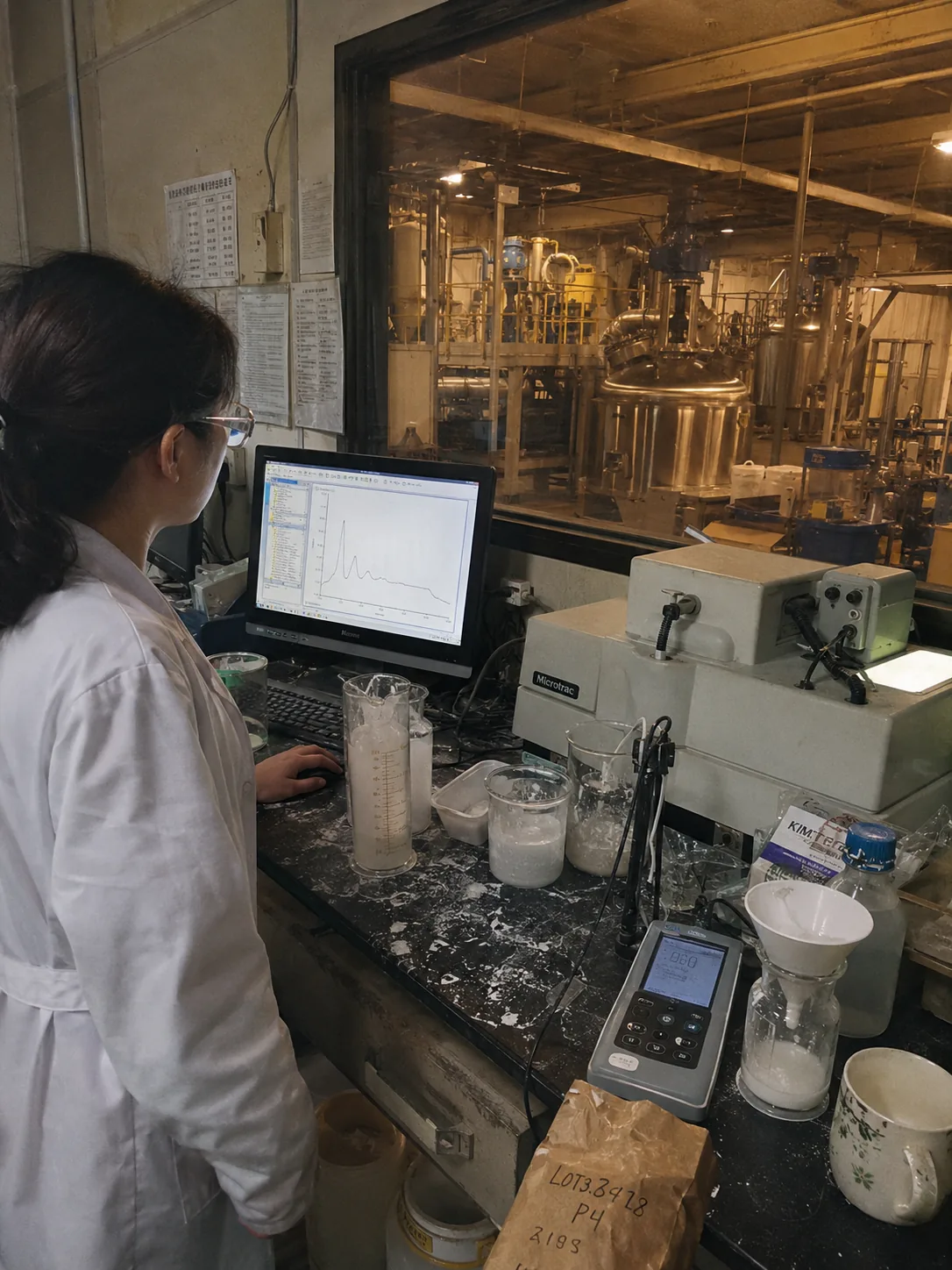
We purchased current commercial lots of both grades, and measured them in our Fujian laboratory over 2025 Q4 – 2026 Q1 with a single method set: particle size by laser diffraction (Malvern), surface area by N₂ adsorption, oil absorption by DBP where the sample allowed, pH in 5% suspension. Application behaviour was assessed in one waterborne acrylic system: drawdowns cured and conditioned at 85% relative humidity for blushing, suspension observed over 7 days, and clarity, touch and matting efficiency rated side by side at equal loading on identical panels. Star ratings are relative in-house assessments; all figures are our measurements, not the manufacturers’ published specifications, and the manufacturers’ controlled values may differ.
3. The numbers
| Parameter | ACEMATT® OK 412 | SYLOID® ED 30 | What it means |
|---|---|---|---|
| Manufacturing route | Precipitated silica | Silica gel | Gel route gives higher, more uniform pore volume |
| Median particle size d50 | 6.3 μm | 5.5 μm | Finer ED 30 reads as finer touch |
| Pore volume | 1.5 mL/g | 1.8 mL/g | Higher pore volume → higher matting efficiency |
| Specific surface area (N₂) | 130 m²/g | 300 m²/g | The largest structural gap between the two |
| Oil absorption | 250 g/100 g (DOA) | 300 g/100 g (DBP) | Higher uptake → more viscosity impact |
| Carbon content (wax level) | 5.5% | 7.5% | More wax → better suspension behaviour |
| pH (5% suspension) | 6.3 | 7.2 | OK 412 near-neutral; ED 30 mildly alkaline |
| Clarity on dark panel | ★★★★☆ | ★★★★★ | Gel structure scatters less |
| Matting efficiency at equal loading | ★★★★☆ | ★★★★★ | Pore volume shows up here |
| Viscosity impact at equal loading | ★★☆☆☆ low | ★★★★☆ higher | OK 412's signature advantage |
| Surface smoothness (touch) | ★★★★☆ | ★★★★★ | Wax level + finer d50 |
| Blushing after cure, 85% RH | Slight ★★★☆☆ | Slight ★★★☆☆ | Shared weakness in tropical service |
| Suspension, 7 days waterborne | Soft sediment, redispersible | Slight soft sediment | Both manageable with stir-in |
The structural story is compact: the gel route gives ED 30 a fifth more pore volume and well over twice the surface area of the precipitated OK 412. Pore volume drives how much film-surface roughening you get per kilogram of silica — matting efficiency. Surface area (together with oil absorption) drives how much resin and water the particle immobilises — viscosity. Each grade’s reputation is simply its structure speaking.
4. Where each grade wins
Choose the OK 412 profile when viscosity is the constraint
In our system, OK 412’s thickening tendency rated low against ED 30’s noticeably higher impact. In low-solids clears, spray-ready furniture systems, or any formulation already running close to its viscosity ceiling, that headroom is worth more than a half-star of matting efficiency — you can simply dose a little higher and stay sprayable. Its near-neutral pH (6.3 measured) is also the gentler choice in pH-sensitive systems.
Choose the ED 30 profile when efficiency and touch are the constraint
ED 30’s 1.8 mL/g pore volume delivered the highest matting efficiency in the test, and its finer d50 (5.5 vs 6.3 μm measured) plus higher wax level (7.5% vs 5.5% carbon) showed up directly in surface smoothness and clarity on dark panels. For deep-matte premium finishes where hand feel sells the product, the gel structure is the benchmark for a reason.
5. The weakness they share
At 85% relative humidity — an ordinary wet-season afternoon in Ho Chi Minh City — both grades blushed slightly on our dark panels. Neither is engineered primarily for tropical waterborne service; both were developed as solvent/waterborne universal grades. Suspension behaviour was manageable for both (soft, redispersible sediment for OK 412; slight soft sediment for ED 30 over 7 days), but in waterborne storage both reward anti-settling attention. If high-humidity whitening is your live failure mode, the mechanism and fixes are covered in our high-humidity whitening guide.
6. Where Censil sits in this picture
Our own grades were developed against exactly this trade-off: Censil361C combines OK 412’s low-viscosity behaviour with 1.8 mL/g pore volume, and Censil660 / Censil1650A match ED 30’s efficiency class — all wax-modified with high-melting PE wax specifically for waterborne systems, and none of them blushed at 85% RH in the same parallel test. The full lab tables are on the benchmark pages: OK 412 → Censil361C and ED 30 → Censil660 / 1650A. A free 2 kg sample ships with the benchmark sheet so you can reproduce the comparison on your own line.