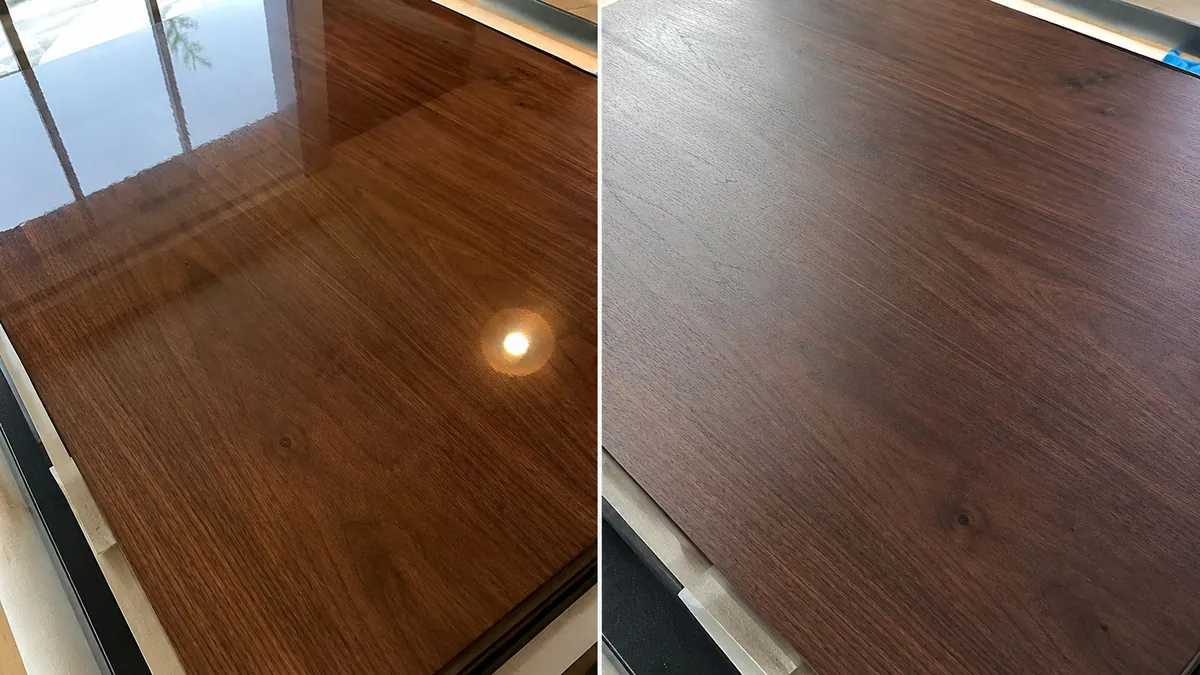
TL;DR: Achieving crystal-clear matte finishes on dark solid wood with waterborne coatings requires a matting agent with a tight particle size distribution around 5 μm and wax-modified surface treatment. Censil660 (d50 5.0–5.3 μm) delivers zero haze at 2–3% dosage even at 85% relative humidity — matching SYLOID® ED 30 performance at 20–30% lower cost.
The Problem: White Haze on Dark Wood Ruins Premium Finishes
Dark solid wood species — walnut, teak, mahogany, wenge — command premium prices in the Southeast Asian furniture market. A single dining table made from Burmese teak can exceed USD 3,000 in retail. The last thing any manufacturer wants is a cloudy, whitish topcoat that masks the grain and kills the visual depth.
Waterborne clear topcoats have largely replaced solvent-based systems across Vietnam and Malaysia, driven by VOC regulations and worker safety concerns. But waterborne matte finishes introduce a stubborn defect: haze. Unlike solvent systems where the matting agent sits in a transparent resin matrix, waterborne formulations scatter light differently — especially on dark substrates where even minor scattering becomes visible as a milky film.
Two mechanisms cause this haze:
- Silica light scattering — When matting agent particles are too large or have a broad size distribution, they scatter visible light (400–700 nm wavelength). Particles above 6 μm create noticeable haze; particles in the 4.5–5.5 μm range sit below the visible scattering threshold.
- Blushing from moisture entrapment — At relative humidity above 75%, water evaporates slowly from the wet film. Trapped moisture forms micro-voids as the film coalesces, creating a secondary whitening effect that has nothing to do with silica.
The critical insight: most "haze" complaints in tropical factories are actually a combination of both mechanisms, and blaming the matting agent alone misses half the problem.
Why Narrow Particle Size Distribution Matters More Than Average Size
Specification sheets list a single d50 value — but that number hides the distribution width. Two matting agents can both claim "d50 = 5 μm" yet perform completely differently.
A broad distribution (e.g., d10 = 2 μm, d90 = 12 μm) means 10–15% of particles exceed the haze threshold. Those oversized particles act as light diffusers, creating the milky appearance that ruins dark wood finishes.
A narrow distribution (d10 = 3.5 μm, d90 = 7.0 μm) keeps 95%+ of particles within the non-scattering range. The visual result: matte sheen without any cloudiness.
Censil660 achieves a d50 of 5.0–5.3 μm with a distribution span (d90–d10)/d50 below 0.8. For comparison, conventional precipitated silica matting agents often show span values above 1.2. This tighter control is what enables haze-free performance on dark substrates at gloss levels of 15–25 GU (60°).
For applications requiring even finer surface texture — such as high-gloss clear coats with subtle satin reduction — Censil651 (d50 4.9–5.2 μm) offers a slightly smaller particle size that sits further from the scattering boundary.
Wax-Modified Surface Treatment: The Anti-Sediment Advantage
Precipitated silica has a density of approximately 2.0 g/cm³ — roughly double that of waterborne acrylic resins (0.9–1.1 g/cm³). Without intervention, silica particles settle to the bottom of the can within hours.
Standard surface treatments use hydrophobic agents like HMDS (hexamethyldisilazane) to reduce silica's affinity for water. This slows settling but does not prevent it entirely. After 2–4 weeks in storage, standard-treated silica forms a soft sediment that can be redispersed with moderate stirring — acceptable for most applications.
Wax-modified surface treatment takes a different approach. A microcrystalline wax layer coats each silica particle, creating a physical barrier that prevents particle-to-particle contact. Even when particles settle, they cannot pack tightly enough to form hard aggregates.
The practical difference becomes obvious in hot climates. In Vietnamese factories where warehouse temperatures regularly hit 35–38°C, standard-treated silica accelerates sediment hardening. Wax-modified grades like Censil660 maintain full redisperseability after 6 months at 40°C — no high-shear mixer required, just a slow-speed stir at 200–300 rpm for 5 minutes.
Field Comparison: Censil660 vs. Industry Benchmark at 85% RH
A controlled comparison was conducted at a furniture factory in Binh Duong Province, Vietnam, during the peak rainy season (ambient RH: 83–87%, temperature: 30–32°C).
Setup: - Substrate: American black walnut panels (120 × 60 cm), sanded to 320-grit - Coating system: Waterborne acrylic-polyurethane hybrid clear topcoat - Matting agents tested: Censil660 at 2.5% vs. SYLOID® ED 30 at 2.5% (both by weight of total formulation) - Application: HVLP spray, 120 μm wet film thickness - Drying: Ambient, 24 hours
Results:
| Parameter | Censil660 | SYLOID® ED 30 |
|---|---|---|
| Gloss (60°) | 22 GU | 21 GU |
| Haze (visual, dark substrate) | None detectable | None detectable |
| Sediment after 3 months (40°C) | Soft, easily redispersed | Soft, easily redispersed |
| Surface smoothness (orange peel) | Excellent | Excellent |
| Wood grain clarity | High | High |
Both products performed equivalently under these conditions. The key differentiator emerged in cost: Censil660 delivered identical visual performance at approximately 25% lower material cost per litre of finished coating, with a minimum order quantity of 500 kg versus multi-ton commitments.
Formulation Guidelines for Dark Wood Matte Topcoats
Recommended dosage: 1.5–3.5% Censil660 by total formulation weight. Start at 2.0% for a 20–25 GU semi-matte finish; increase to 3.0–3.5% for 10–15 GU matte.
Dispersion protocol: 1. Pre-disperse Censil660 in the aqueous phase (water + co-solvent) using a high-speed disperser at 1,500–2,000 rpm for 15–20 minutes. 2. Target a Hegman gauge reading of 5+ (particles fully deagglomerated). 3. Add resin and additives after silica dispersion is complete — adding silica to a finished coating risks incomplete breakdown. 4. Final let-down with rheology modifier at low speed (300–500 rpm) to avoid re-agglomeration.
Humidity management: When factory RH exceeds 80%, add 2–3% slow-evaporating co-solvent (e.g., dipropylene glycol n-butyl ether) to prevent moisture blushing. This addresses the non-silica component of haze.
Anti-settling insurance: For formulations stored over 3+ months, combine Censil660 with 0.2–0.5% fumed silica (hydrophilic grade) to provide thixotropic body that suspends the precipitated silica particles. This "dual silica" approach is detailed further in our sediment prevention guide.
Grade Selection Quick Reference
| Application | Recommended Grade | Target Gloss (60°) | Dosage |
|---|---|---|---|
| Dark wood, semi-matte | Censil660 | 20–25 GU | 2.0–2.5% |
| Dark wood, full matte | Censil660 | 10–15 GU | 3.0–3.5% |
| Dark wood, satin/high clarity | Censil651 | 25–35 GU | 1.5–2.0% |
| Light wood, general purpose | Censil361C | 15–25 GU | 2.0–3.0% |
| Extreme matte, furniture | Censil1650A | 5–10 GU | 3.5–4.0% |
FAQ
What causes white haze in waterborne matte clear coats on dark wood?
Two separate mechanisms: (1) light scattering from matting agent particles that are too large or too broadly distributed, and (2) moisture blushing from slow drying in high-humidity conditions. Narrow particle size distribution (d50 ≈ 5 μm) solves the first; co-solvent adjustment and controlled drying solve the second. Censil660 addresses both through its tight d50 of 5.0–5.3 μm and wax-modified surface that resists moisture-related defects.
Can I use the same matting agent for both dark wood and light wood?
Yes, but optimization differs. Dark wood shows haze more easily, so tighter particle size control matters. Censil660 (d50 5.0–5.3 μm) works on both dark and light substrates. For light wood or natural finishes where maximum grain pop is desired, Censil651's slightly smaller particles (d50 4.9–5.2 μm) offer marginally better clarity at the cost of slightly lower matting efficiency.
How much matting agent should I add to my waterborne topcoat?
Start at 2.0% by total formulation weight for a 20–25 GU semi-matte finish on dark wood. Increase to 3.0–3.5% for 10–15 GU full matte. Always test in 0.5% increments — matting efficiency is non-linear, and a 0.5% increase can drop gloss by 5–8 GU depending on the resin system. Exceeding 4% rarely improves matte performance and begins to harm film properties.
Will the matting agent settle in the can during storage?
All precipitated silica settles — the question is whether it forms a hard cake or stays soft. Censil660 and Censil651 use wax-modified surface treatment that prevents particle-to-particle bonding during settling. After 6 months at 40°C, sediment redispersees with a slow-speed stir (200–300 rpm, 5 minutes). For extended storage in tropical conditions, adding 0.3% fumed silica provides additional thixotropic suspension.
Is Censil660 a direct replacement for SYLOID® ED 30?
Yes. Censil660 matches SYLOID® ED 30 in particle size (d50 5.0–5.3 μm), matting efficiency, and clarity performance. In side-by-side testing on dark walnut at 85% RH, both achieved 21–22 GU with zero detectable haze. Censil660 offers 20–30% cost savings with a lower MOQ (500 kg minimum vs. multi-ton). Run a small batch trial first to confirm compatibility with your specific resin system.