Product Range

The Censil silica matting series

Waterborne-focused matting agents — engineered where clarity, touch and storage stability matter most.

Every grade is built as a 1:1 drop-in for a specific European benchmark, with particle size, pore volume and surface area mapped to the finish you need.

Quick answer

Which Censil grade replaces the imported grade I use today?

Each Censil grade is built as a 1:1 drop-in for a specific European benchmark: Censil660 and Censil1650A for SYLOID® ED 30, Censil651 for ED 2, Censil351C for ED 3, Censil361C for ED 4, and Censil3851 for ACEMATT® TS 100 — while Censil1531D is a cost-optimized grade with no direct benchmark. All grades share 1.6–1.8 mL/g pore volume and 250–280 m²/g surface area, with d50 ranging from 4.8 to 9.0 μm. Everything ships in 20 kg paper-plastic laminated bags, palletized for containers.

Low-VOC ready

Designed for waterborne systems

Amorphous silica

CAS 112926-00-8 · no crystalline silica

The 20 kg range

Supplied in 20 kg paper-plastic laminated bags, palletized for container export. Lead grades for each solution:

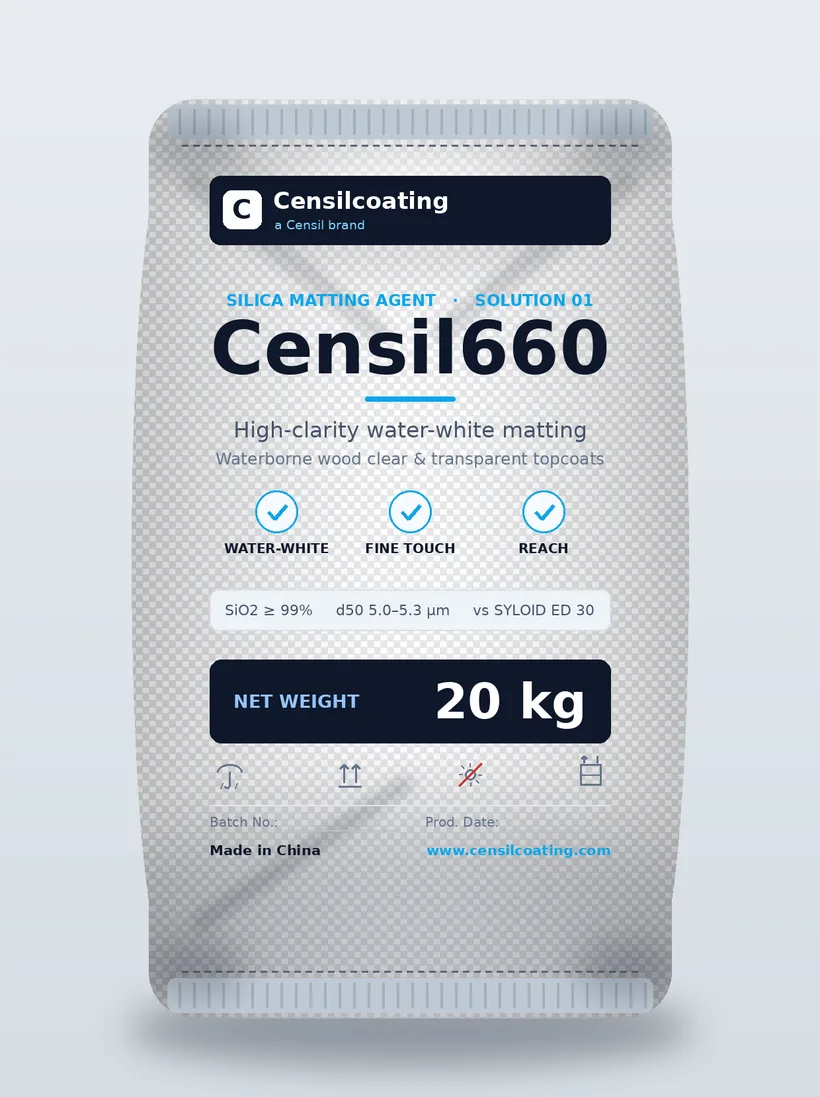
Censil660 20 kg silica matting agent packaging bag

Censil660 · 20 kg

Solution 01 · High-clarity water-white · vs SYLOID ED 30

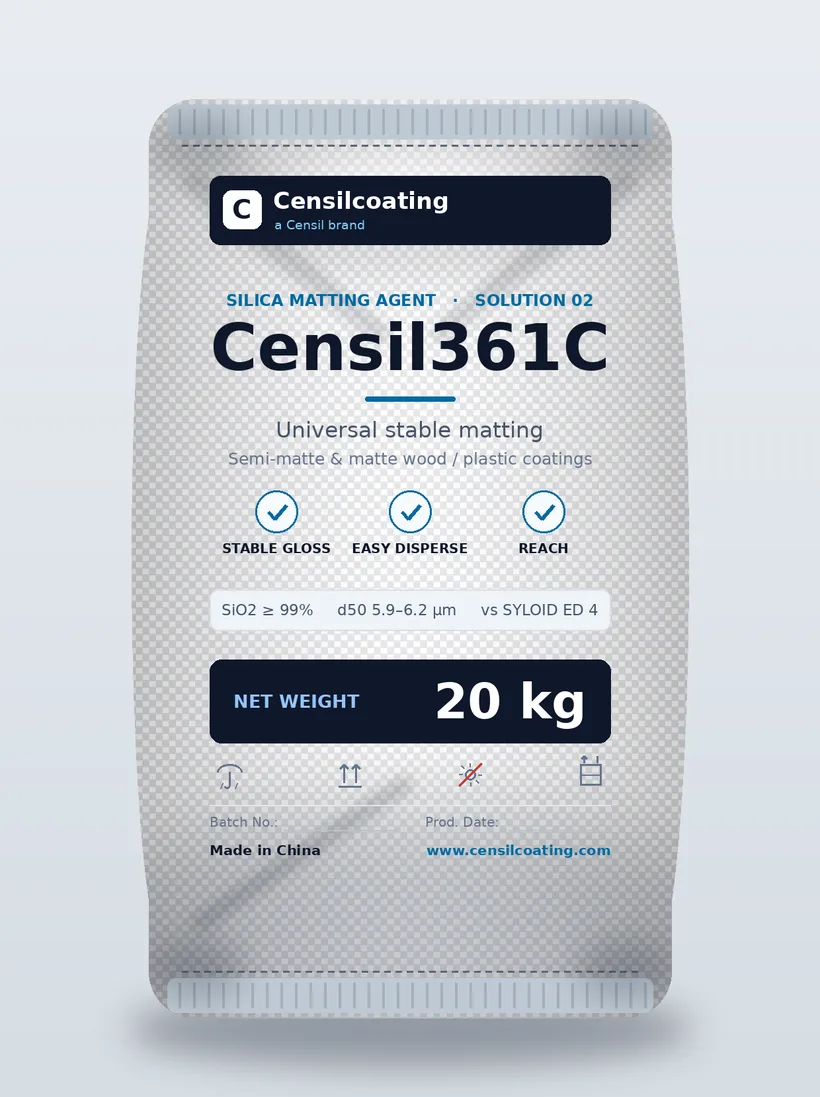
Censil361C 20 kg silica matting agent packaging bag

Censil361C · 20 kg

Solution 02 · Universal stable · vs SYLOID ED 4

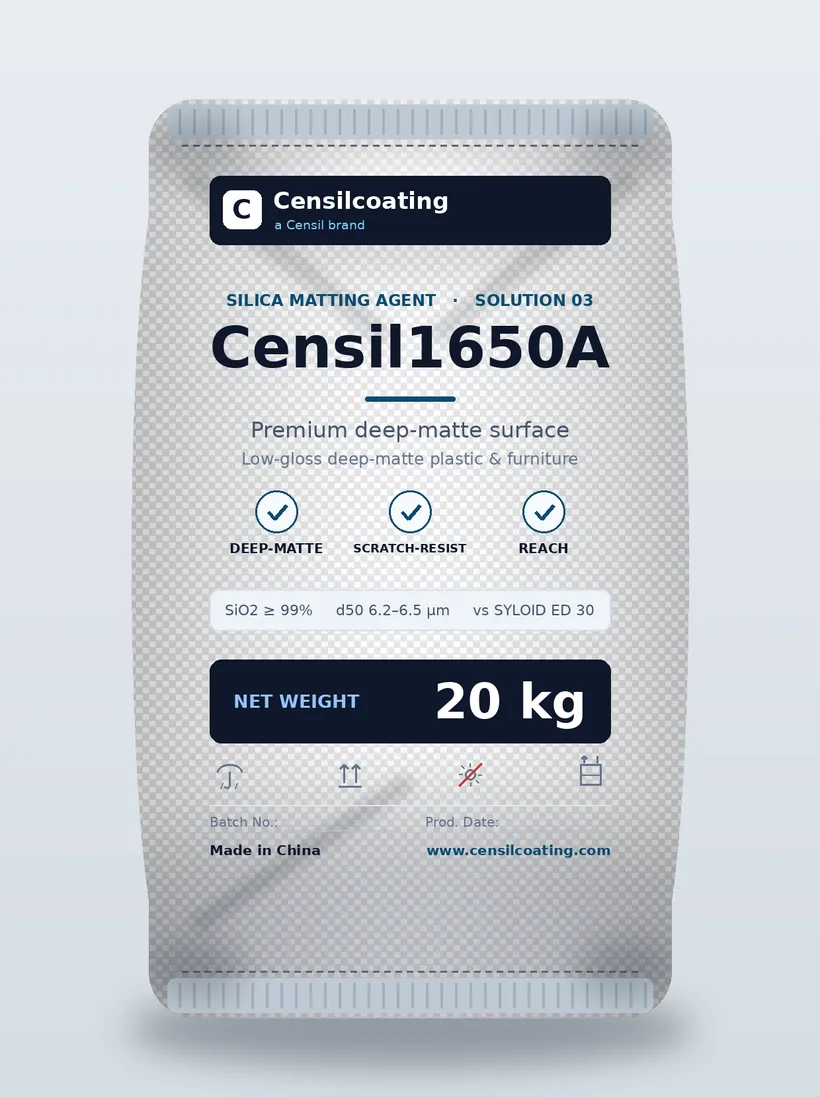
Censil1650A 20 kg silica matting agent packaging bag

Censil1650A · 20 kg

Solution 03 · Premium deep-matte · vs SYLOID ED 30

Also available in the same 20 kg format: Censil651, Censil351C, Censil1531D and Censil3851. Custom packaging on request.

Product line-up

Seven grades engineered for waterborne wood and plastic coatings — each tuned by particle size and surface treatment to a target finish and import benchmark.

LEAD Censil660

High-Clarity Water-White

Water-white clear topcoats and high-transparency wood-grain clears. Matte with zero haze on dark solid wood.

d50
5.0–5.3 μm
Benchmark
SYLOID® ED 30
Finish
High-clarity matte
Request sample
What is Censil660 used for?
Water-white clear topcoats and high-transparency wood-grain clears. At 5.0–5.3 μm it matts the surface without introducing visible haze, which is why it is the lead grade on dark solid wood where any clouding would show.
Which imported grade does Censil660 replace?
SYLOID® ED 30, as a 1:1 drop-in. Pore volume (1.6–1.8 mL/g) and surface area (250–280 m²/g) are matched to the benchmark, so the switch is a like-for-like dosage comparison rather than a reformulation.
What starting dosage should I use for Censil660?
1–4% is the recommended range across the Censil series. Start mid-range, measure gloss at your normal film build, then adjust — final performance must be validated against your resin system, dispersion method and additive package.
SUPPORT Censil651

Fine-Touch Clarity

Finer particle route for high-clarity semi/matte clears — emphasizes transparency, smoothness and a fine hand-feel.

d50
4.9–5.2 μm
Benchmark
SYLOID® ED 2
Finish
Fine semi/matte
Request sample
What is Censil651 used for?
High-clarity semi-matte and matte clears where touch matters. The finer 4.9–5.2 μm particle route emphasizes transparency, surface smoothness and a fine hand-feel.
Censil651 or Censil660 — which should I pick?
Censil660 (5.0–5.3 μm, benchmark SYLOID® ED 30) leads on water-white transparency. Censil651 (benchmark SYLOID® ED 2) leads on fine hand-feel and smoothness. If the complaint you are solving is that the surface feels rough, start with Censil651.
SUPPORT Censil351C

Universal Fine

A fine, universal grade balancing surface appearance with broad stability — a smooth bridge toward high-clarity systems.

d50
4.8–5.1 μm
Benchmark
SYLOID® ED 3
Finish
Universal matte
Request sample
What is Censil351C used for?
Fine, universal matte finishes. It balances surface appearance against broad system stability, which makes it a smooth bridge when a line is moving toward high-clarity systems but still runs several different formulations.
When should I choose Censil351C over Censil651?
Choose Censil351C (benchmark SYLOID® ED 3) when one fine grade has to behave predictably across several systems. Choose Censil651 (benchmark SYLOID® ED 2) when a single high-clarity system needs the best possible touch.
LEAD Censil361C

Universal Stable

The workhorse for semi-matte to matte wood and plastic coatings — high matting efficiency with a stable, scalable window.

d50
5.9–6.2 μm
Benchmark
SYLOID® ED 4
Finish
Semi-matte / matte
Request sample
What is Censil361C used for?
Semi-matte to matte waterborne wood and plastic coatings. At 5.9–6.2 μm it carries the highest matting efficiency in the range with a stable, scalable formulation window — the workhorse grade for production lines.
Does Censil361C replace ACEMATT® OK 412?
Yes. Censil361C is the 1:1 reference grade for both SYLOID® ED 4 and ACEMATT® OK 412, which makes it the most common first switch when a line moves off an imported matting agent.
Is Censil361C suitable for thin-film plastic coatings?
Yes — it is the recommended grade for waterborne plastic coatings at 10–15 μm film build. In thin films a coarser grade would show as surface roughness, so matting efficiency at a controlled particle size is what matters.
COST Censil1531D

Cost-Optimized

A stable, cost-efficient transition grade — ideal for first-round substitution, small trials and price-sensitive projects.

d50
5.3–5.6 μm
Benchmark
Cost-optimized
Finish
Universal matte
Request sample
Why does Censil1531D have no import benchmark?
Because it is not built as a copy of a European product. Censil1531D (5.3–5.6 μm) is a cost-optimized transition grade, designed to prove stable behaviour in your system before you commit to a full grade-for-grade switch.
When should I choose Censil1531D?
For first-round substitution, small trials and price-sensitive projects. It shares the same 1.6–1.8 mL/g pore volume and 250–280 m²/g surface area as the benchmarked grades, so results carry over when you later move to Censil361C or Censil660.
LEAD Censil1650A

Deep-Matte Premium

Low-gloss deep-matte for high-end plastic coatings and tactile furniture — uniform, fine and scratch-resistant, never coarse.

d50
6.2–6.5 μm
Benchmark
SYLOID® ED 30
Finish
Low-gloss deep-matte
Request sample
What is Censil1650A used for?
Low-gloss deep-matte finishes on high-end plastic coatings and tactile furniture. At 6.2–6.5 μm it develops a uniform, fine and scratch-resistant surface rather than the coarse feel a larger particle would give.
Censil1650A or Censil3851 for deep matte?
Censil1650A when the surface still has to feel fine and premium — furniture, 3C and automotive trim. Censil3851 (8.5–9.0 μm) only when the target is extreme low gloss on hard plastic or industrial surfaces and hand-feel is secondary.
SPECIAL Censil3851

Special Reserve

A large-particle reserve grade for hard, extreme low-gloss cases and special plastic / high-end industrial surfaces.

d50
8.5–9.0 μm
Benchmark
ACEMATT® TS 100
Finish
Extreme low-gloss
Request sample
What is Censil3851 used for?
Extreme low-gloss cases and special plastic or high-end industrial surfaces. At 8.5–9.0 μm it is the largest particle in the range and is benchmarked against ACEMATT® TS 100.
When should I not use Censil3851?
When transparency or fine hand-feel is part of the specification. Its particle size is reserved for hard, extreme low-gloss work — for premium tactile deep-matte use Censil1650A, and for clarity-led clears use Censil660 or Censil651.

Application selector

Find the recommended grade by application, system and target finish — built for waterborne wood and plastic coatings.

Segment System Target finish Recommended grades
Wood coatings Waterborne clear topcoat (acrylic / PUD / UV) High-clarity matte Censil660, Censil651
Wood coatings Waterborne Semi-matte / matte Censil361C, Censil351C
Wood coatings Waterborne (first import / cost-sensitive) Universal matte Censil1531D
Plastic coatings Waterborne (thin film 10–15μm) Semi-matte / matte Censil361C
Plastic coatings Waterborne (3C / automotive trim) Deep-matte Censil1650A, Censil3851
Premium furniture Waterborne tactile finish Low-gloss deep-matte Censil1650A, Censil361C

Grades & 1:1 benchmarks

Request full TDS
Grade Particle size d50 (μm) Pore volume (mL/g) Surface area (m²/g) 1:1 benchmark Best for
Censil660 5.0 – 5.3 1.6 – 1.8 250 – 280 SYLOID® ED 30 High-clarity water-white clear topcoats; "water-white" appearance
Censil651 4.9 – 5.2 1.6 – 1.8 250 – 280 SYLOID® ED 2 Fine touch & smooth surface in high-clarity semi/matte clears
Censil351C 4.8 – 5.1 1.6 – 1.8 250 – 280 SYLOID® ED 3 Fine, universal finishes balancing appearance & stability
Censil361C 5.9 – 6.2 1.6 – 1.8 250 – 280 SYLOID® ED 4 · ACEMATT® OK 412 Universal semi-matte/matte; higher matting efficiency
Censil1531D 5.3 – 5.6 1.6 – 1.8 250 – 280 Cost-optimized First-round substitution, small trials, cost-sensitive projects
Censil1650A 6.2 – 6.5 1.6 – 1.8 250 – 280 SYLOID® ED 30 Low-gloss deep-matte; premium surface development
Censil3851 8.5 – 9.0 1.6 – 1.8 250 – 280 ACEMATT® TS 100 Special-reserve grade for extreme low-gloss / hard plastic surfaces

Values are typical guidance figures; final performance must be validated against your resin system, dispersion method and additive package. Full Technical Data Sheets (TDS) available on request.
Typical physicochemical properties

Shared characteristics across the Censil silica matting range. Grade-specific particle size, pore volume and surface area are listed in the table above.

Appearance
White powder
Silica content (SiO₂, dry)
≥ 99%
CAS number
112926-00-8
pH (5% suspension)
6.0 – 8.0
Loss on drying (105°C)
≤ 6.0%
Residue (325 mesh)
≤ 0.05%
Tapped bulk density
90 – 150 g/L
Surface treatment
Wax-modified*
Recommended dosage
1 – 4%
Packaging
20 kg / bag

*Surface treatment (organic / PE-wax modification) is grade-dependent. Typical guidance values — refer to the grade TDS for the controlled specification.

How the grades map to solutions

We recommend a "lead + support" structure rather than a single grade, so we can match different customer needs precisely.

01 · High-Clarity Water-White

  • LEADCensil660 — vs ED 30, water-white appearance
  • SUPPORTCensil651 — finer, smoother touch
  • BRIDGECensil351C — upgrade path from universal matte

02 · Universal Stable Matting

  • LEADCensil361C — vs ED 4, higher matting efficiency
  • SUPPORTCensil351C — finer universal route
  • COSTCensil1531D — first-import transition option

03 · Premium Deep-Matte

  • LEADCensil1650A — vs ED 30, low-gloss deep-matte
  • BALANCECensil361C — gloss vs fineness balance
  • SPECIALCensil3851 — vs TS 100, hard cases

The technology

What makes a matting agent perform in waterborne systems

Performance in high-humidity waterborne coatings comes from surface chemistry and particle engineering — not just raw silica.

High-melt PE wax modification

Surface wax treatment prevents hard sedimentation in low-viscosity systems and delivers a fine, smooth touch.

Narrow particle-size control

Tight d50 control (3.5–9.0μm) balances transparency and matting efficiency for water-white clarity.

Matting + anti-settling combo

Paired with fumed-silica thixotropy for anti-settling stability across the waterborne window.

High-purity amorphous silica

Amorphous, high-purity dry basis — no crystalline silica — for zero haze on dark substrates.

Quality control, batch by batch

Every parameter published in our spec table is tested before release — and certified on the COA that ships with each batch.

1

Incoming inspection

Raw materials verified against controlled specifications before entering production.

2

Particle-size control

d50 and distribution width measured by laser diffraction — held within the published range for every grade.

3

Surface-treatment check

Wax-modification level verified per grade — the parameter behind anti-settling and touch.

4

Physicochemical panel

Moisture (105°C), 325-mesh residue ≤0.05%, pH 6.0–8.0, tapped density — tested per batch.

5

COA release

Batch released only against spec, with a Certificate of Analysis issued for every shipment.

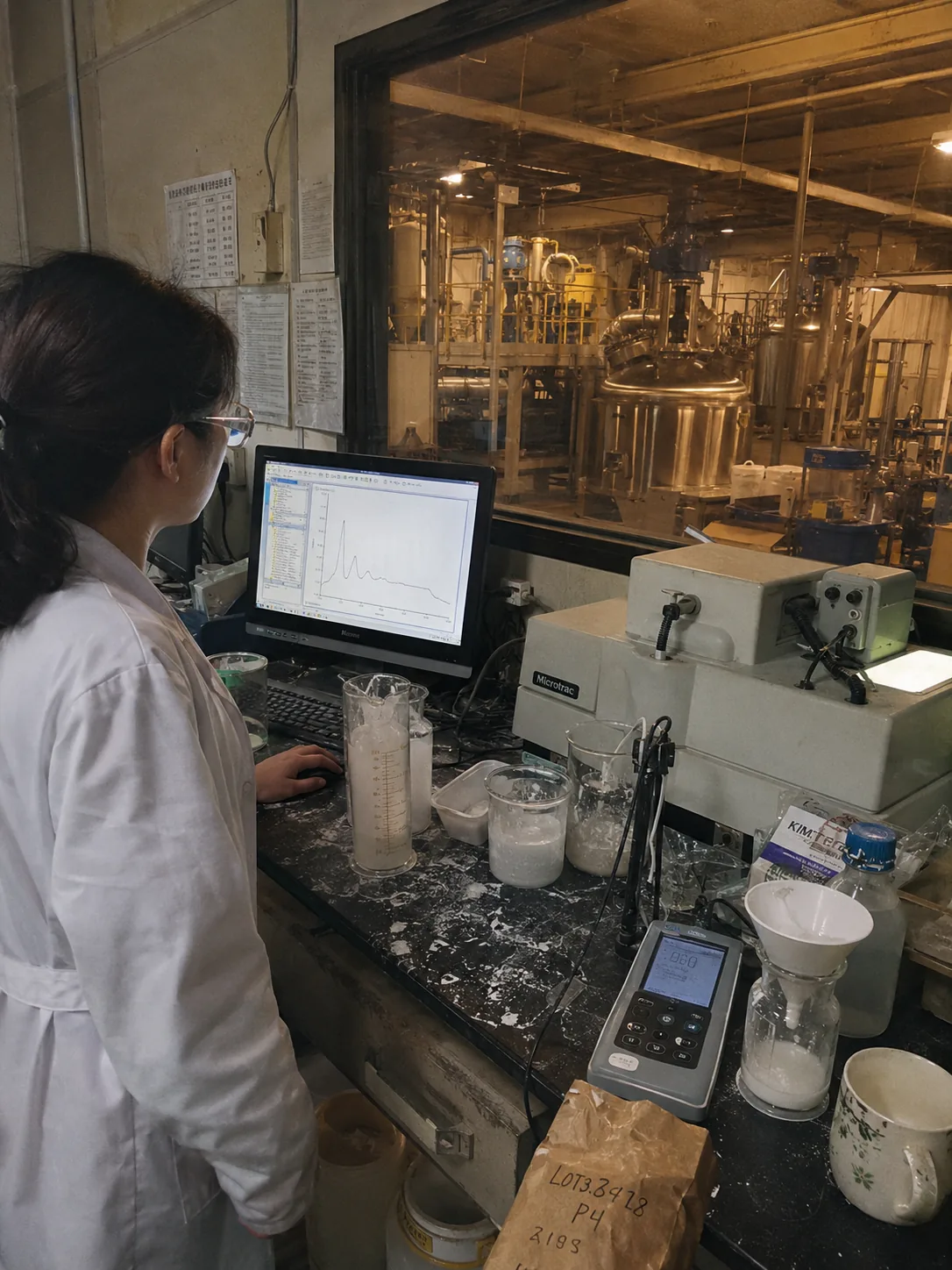
QC technician running laser-diffraction particle-size analysis on a Microtrac analyzer, with the production floor visible behind the lab window
Laser-diffraction particle-size analysis in our QC lab — production floor on the other side of the window.

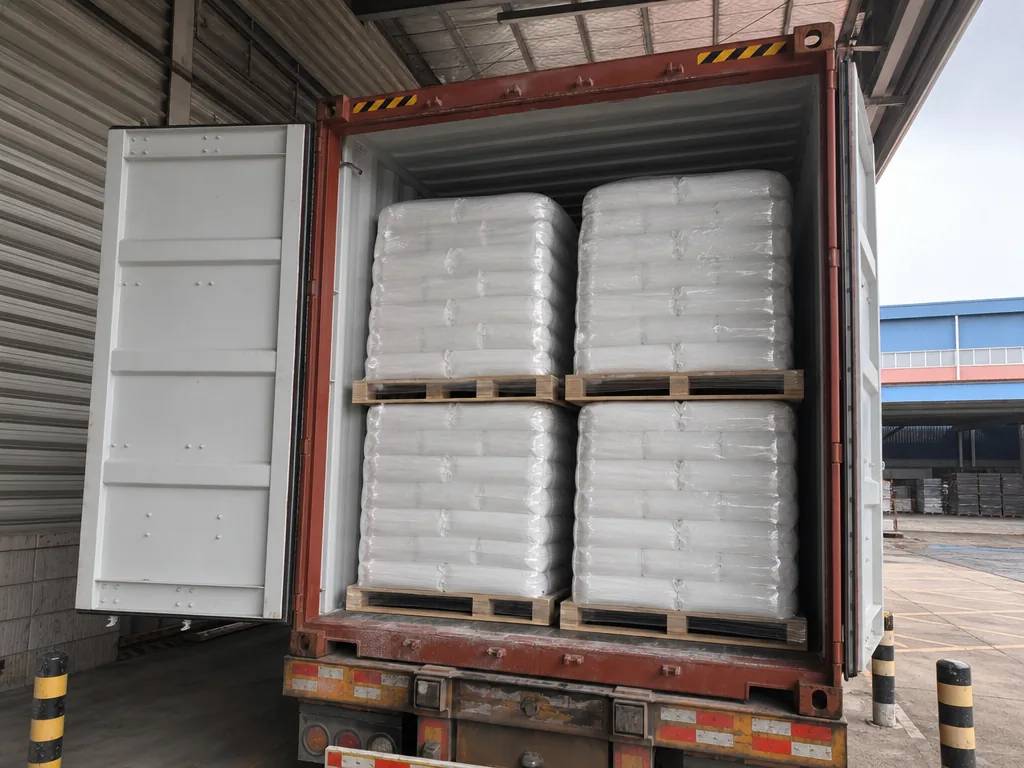
Packaging & delivery, export-ready

From Fujian to your warehouse — a short, predictable supply chain built for Southeast Asia.

📦

20 kg paper-plastic laminated bags

Moisture-protected paper-plastic laminated bags; custom packaging available on request.

🧱

Palletized & wrapped

Stretch-wrapped pallets sized for clean container loading and forklift handling.

🚢

FCL or LCL

Full container or consolidated shipments — matching your volume from 500 kg up.

⏱️

2–3 weeks door-to-port

3–7 days sea freight to Vietnam, 5–9 days to Malaysia — with COA, SDS and shipping docs in the pack.

Stretch-wrapped pallets of 20 kg silica bags loaded into a shipping container
Palletized 20 kg bags, stretch-wrapped and container-loaded at source.

Documentation, ready on request

Everything your lab and procurement team need to evaluate and approve a switch — sent on request.

Technical Data Sheets (TDS) — controlled specification per grade, full range

1:1 benchmark sheet — physicochemical parity & application advantages (EN/CN)

Safety Data Sheet (SDS) — handling, storage and safety information

Not sure which grade matches your import product?

Send us the grade you currently use and your target gloss — we'll recommend the right lead + support pairing and ship a free 2 kg sample.

Request a Free 2 kg Sample